
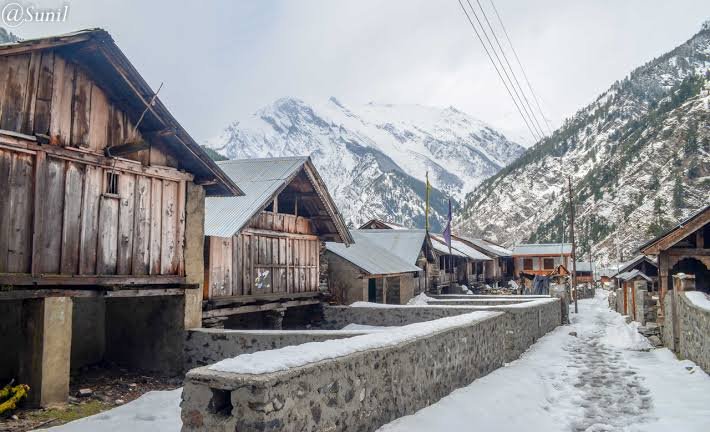
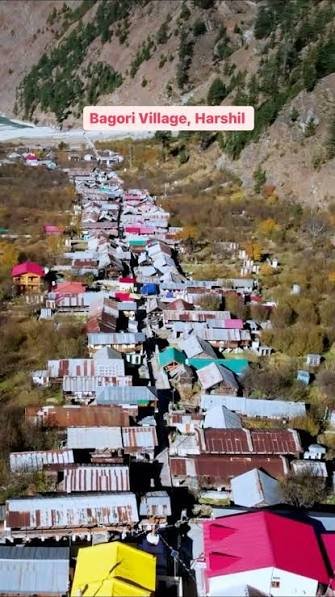
Bagori Village sits in the Harsil Valley of Uttarkashi district, Uttarakhand, at roughly 2,520 meters on the banks of the Bhagirathi river, just a few minutes from Harsil itself. Bagori Village Uttarakhand is known for two very different things at once: it’s one of the most complete surviving Jad Bhotia (Indo-Tibetan) settlements in the Garhwal Himalaya, and for nearly six months a year, it’s almost entirely empty — locals call it the “ghost village” because sub-zero winters force residents down to warmer towns like Dunda, leaving stone-and-timber lanes silent under snow until the community returns each spring.
This guide covers the Jad community’s history, traditional architecture, culture, homestays, weather by month, and 23 answered questions — everything you need to visit Bagori Village Uttarkashi with real understanding, not just a photo stop on the way to Gangotri.
Where Is Bagori Village?
Bagori Village sits in the Harsil Valley of Uttarkashi district, Uttarakhand, at approximately 2,520 meters, on the banks of the Bhagirathi river, roughly 5 minutes from Harsil, 20 km from Dharali, and about 37 km from Gangotri.
The village sits back from the main Uttarkashi–Gangotri highway, reached by a short approach lane. It isn’t a stop on the way to somewhere more famous — for most of the year it barely registers on a typical Char Dham itinerary — which is exactly why its Jad Bhotia culture and architecture have stayed as intact as they have.
Planning to include Bagori in your Harsil Valley trip? Kashi of North arranges homestay bookings and local guides so you’re not showing up unannounced in a village this small — WhatsApp +91 7253079221.
Why Is Bagori Called the Ghost Village?
Bagori earns its “ghost village” nickname because sub-zero winter temperatures freeze water lines and make daily life impossible, so residents relocate to warmer towns like Dunda for roughly six months, leaving the village almost entirely deserted from late November through April.
Walking through Bagori’s empty lanes during this period is genuinely eerie — locked wooden doors, snow settling undisturbed on stone steps, and the only sounds being your own footsteps and a distant temple bell carried on the wind. Residents typically return during the warmer months, roughly May through November, when the village comes fully back to life with agricultural work, homestay guests, and the ordinary rhythm of mountain life.
History of Bagori Village
Bagori’s history is inseparable from the Jad Bhotia community’s centuries-old role in Indo-Tibetan trade — a role that ended abruptly after the 1962 Sino-Indian War, when the community’s original homeland in Nelong Valley became a closed military zone and its people resettled permanently in Bagori and Dunda.
The Trade Route Legacy
Bagori’s position in the upper Bhagirathi Valley was never accidental. The Jad people historically crossed high Himalayan passes to trade with Tibet, carrying grain, spices, and manufactured goods north and returning with salt, wool, and livestock skins. This wasn’t casual barter — it was an organized, centuries-old commercial system with established routes and seasonal markets, most notably the annual “Bada Haat” fair held in Uttarkashi town.
The 1962 Rupture
The Sino-Indian War of 1962 closed the Tibet border permanently, and with it, the trade economy that had defined Jad livelihoods for generations. Families from Nelong and Jadung — the community’s original high-altitude villages — were prevented from returning home once the war broke out, since their homeland had become a sensitive military border zone overnight. By 1965, the valley was fully evacuated, and roughly 40 displaced families were resettled in Bagori (for summer habitation) and Dunda (for winter) — locations that had previously only been their seasonal stopovers.
The economic transition that followed — from centuries of trans-Himalayan trade to agriculture, livestock, and eventually tourism — happened within a single generation and continues to shape the community’s character today.
The Jad (Bhotia) People — Who They Are
The community at Bagori belongs to the Jad, also called Bhotia — a term used across the western Himalaya for communities of partly Tibetan cultural origin who historically engaged in trans-Himalayan trade. “Bhotia” derives from “Bhot,” an older term for Tibet, though the Jad maintain distinct cultural markers separating them from other Bhotia groups elsewhere in Uttarakhand, such as the Tolcha and Marchha communities of Chamoli district.
The Jad speak Jadh Bhoti, a Tibeto-Burman language related to but distinct from standard Tibetan, classified as endangered with active speakers now concentrated mainly among community elders. British-era administrative surveys of the Garhwal region documented the Jad as a distinct community with their own language, dress, and trade specializations — a record that confirms just how long this cultural identity has held its shape here.
Why Bagori Village Is Special
For cultural travelers, Bagori is one of the few accessible places in the Garhwal Himalaya where Jad Indo-Tibetan heritage is visible in the built environment and living daily practice, not staged for visitors. For photographers, the combination of traditional architecture, mountain backdrop, and orchard landscape is genuinely rare. For those interested in endangered languages, hearing Jadh Bhoti spoken at all is geographically limited almost entirely to this valley. And for slow travelers, Bagori simply has no scheduled activity, no guided tour, no admission process — you arrive, walk, observe, and engage with whoever is willing to engage.
Combined with Harsil, Dharali, and Mukhba, Bagori completes a fuller picture of the Harsil Valley’s cultural range — from the Semwal priestly tradition at Mukhba to the Indo-Tibetan heritage here, all linked by the Bhagirathi and the shared apple-orchard economy.
Geography and Altitude
Bagori sits at roughly 2,520 meters, with a summer temperature range of about 10°C to 21°C and winters dropping to -8°C or lower at night. The village’s compact, close-built layout — houses sharing walls — reflects both social practicality and thermal efficiency in an environment where temperatures routinely fall well below zero. The Bhagirathi river runs along the village’s edge, and the surrounding forest transitions from deodar cedar and silver fir at lower elevations to birch and rhododendron higher up.
Culture and Heritage
Bagori’s cultural identity is genuinely syncretic — a blend of Tibetan Buddhist-influenced tradition and Garhwali Hindu practice that reflects centuries of interaction across the trade routes, rather than belonging fully to either tradition.
Deities and Worship
The Jad community maintains traditional local deities (devtas) alongside standard Hindu practice, and some families carry Tibetan Buddhist connections that have persisted despite generations of geographic and political isolation from Tibet itself.
Festivals
The community calendar includes major Hindu festivals like Diwali, Makar Sankranti, and Phool Dei, alongside Jad-specific harvest and spring festivals with their own music and ritual content.
Traditional Attire
Traditional Jad dress is rarely worn day-to-day now but appears at festivals and among older residents — women’s layered woolen garments in dark tones with specific embroidery, and men’s heavy woolen coats adapted for the cold.
Local Crafts
Woolen weaving is the community’s most significant surviving craft. Hand-woven blankets, carpets, and textiles use geometric patterns that echo Tibetan carpet traditions adapted to local material and taste. A small number of families still maintain active looms.
Agriculture
Apple cultivation, introduced to the valley in the mid-20th century, is now the primary cash crop, alongside rajma, mandua (finger millet), and jhangora (barnyard millet) grown mainly for household use — a diversity that reflects both cultural preference and the practical need for food security in a place with unreliable seasonal supply chains.
Traditional Architecture
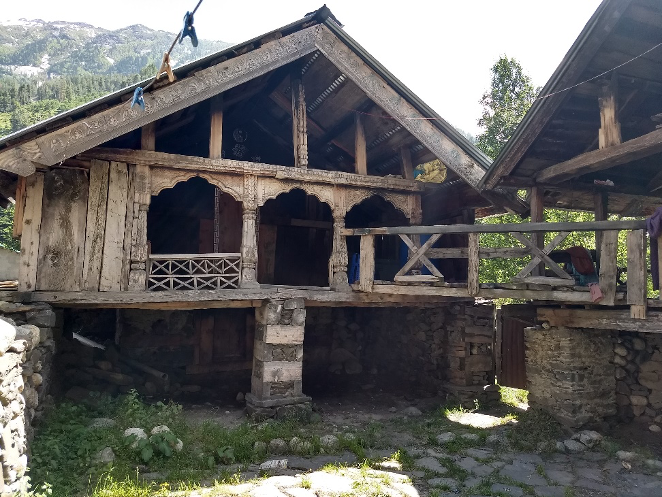
Bagori’s older houses represent one of the most distinctive architectural traditions in the Harsil Valley, using the koti banal stone-and-timber construction technique found elsewhere in Garhwal but with clear Jad-specific adaptations.
| Feature | Description |
|---|---|
| Low doorways | Typically 1.5–1.7 meters high, set in thick stone walls for thermal mass |
| Wide wooden balconies (raan) | Used for drying food, wool, and textiles |
| Flat or near-flat roofs | Adapted for snow-load removal, unusual for the wetter Himalaya |
| Central hearth placement | Designed for maximum radiant heat in small rooms |
| Elevated grain storage | Stone-stilted structures protecting against rodents and damp |
The carved woodwork on older houses — window surrounds, balcony rails — is less ornate than typical Garhwali decoration but more geometrically precise, reflecting the Tibeto-Burman aesthetic sensibility underlying Jad craft. Bagori has around 150 houses, many of them roughly a century old and built entirely from local wood and stone, and the village has been recognized as one of India’s cleanest villages.
Religion and Local Deities
Bagori blends Garhwali Hindu and Buddhist practice in a way that’s visible in its temples. The Tsechen Khakyab Ling Buddhist temple, with its fluttering prayer flags and Tibetan-style architecture, sits alongside Hindu shrines and the community’s own devta tradition — a small structure distinct from standard Garhwali temple iconography, reflecting the Jad’s pre-Hindu, syncretic religious roots. Approach any of these sites with genuine respect, and always ask before photographing ritual objects or ceremonies.
Places to Visit Near Bagori Village
| Place | Distance | Time Required | Best Time |
|---|---|---|---|
| Harsil Village | ~5 minutes | Half day | Year-round |
| Bhagirathi Riverbank | At village edge | 1–2 hours | Year-round |
| Tsechen Khakyab Ling Temple | Within village | 30–60 minutes | Year-round |
| Gartang Gali | ~35 minutes drive | 1–2 hours | May–October |
| Dharali | ~20 km | Half day | Check current status |
| Mukhba Village | ~20–22 km | Half day | Year-round |
| Gangotri Temple | ~37 km | Full day | May–June, September–October |
| Lama Top | Above Harsil | 3–4 hours (trek) | September–October |
| Gangnani Hot Spring | ~40 km toward Uttarkashi | 2–3 hours | Year-round |
Harsil, just minutes away, is the practical base for the whole valley — apple orchards, Wilson Cottage, and the widest accommodation options. Gartang Gali, a 136-meter, roughly 150-year-old wooden pathway hanging from a cliff, was historically used by Indian and Tibetan traders and is now one of the region’s signature adventure stops. Mukhba offers a complementary cultural experience — the Semwal priestly tradition against Bagori’s Indo-Tibetan heritage.
Want to string together Bagori, Harsil, Mukhba, and Gangotri in one trip? Kashi of North designs full Harsil Valley itineraries with transport and local guides included.
Things to Do in Bagori Village
- Walk the traditional lanes slowly, observing carved doorframes, low Jad-style entrances, and wide drying balconies
- Visit local temples and shrines, including the Tsechen Khakyab Ling Buddhist temple
- Meet local weavers — ask at your homestay for an introduction to families still working traditional looms
- Taste traditional Jad cuisine, including butter tea, unavailable at any restaurant
- Walk the apple orchards at Nelong View and Orchard View homestays, especially August–October
- Explore the old village core — the most intact section of traditional architecture, a short walk from the main approach
- Sit by the Bhagirathi riverbank and let the gushing water be the loudest thing you hear
- Bird watch in the forest-orchard interface, best in April–May and September–October
Food and Traditional Jad Cuisine
Bagori’s food culture is the most distinctive in the Harsil Valley. Butter tea, similar to Tibetan po cha, is churned with fat and salt rather than sugar — savory, warming, and genuinely different from anything found on a standard restaurant menu. Other dishes worth trying include tsampa-influenced roasted grain preparations, phanu (a slow-cooked lentil-and-grain dish), mandua ki roti, rajma chawal made with the local mountain bean variety, and jhangora ki kheer. Fresh-pressed apple juice, made in front of you at the orchard, is a simple highlight in season.
There’s minimal commercial food infrastructure in the village — meals happen in homestay kitchens, prepared from what’s in the family’s fields and orchard. Communicate your meal needs in advance when booking.
Shopping Guide
- Hand-woven woolen textiles — blankets, carpets, and clothing from Jad looms, a genuine piece of living craft tradition
- Woolen socks, gloves, and caps knitted by village women
- Local rajma from Bagori’s terrace fields
- Mountain honey, occasionally available from families
- Fresh apples (August–October), farm-gate direct
When buying handwoven textiles or crafts directly from the maker, pay the asking price or negotiate gently — this work represents generational skill, and aggressive bargaining is genuinely inappropriate here.
Where to Stay
Bagori has no hotel — homestays run by Jad families are the only accommodation option in the village itself, which means you cannot visit without engaging directly with the community.
| Stay Type | Price Range (per night) | Notes |
|---|---|---|
| Bagori homestay | ₹2,000–₹3,500 | Usually includes home-cooked meals |
| Harsil guesthouse (5 min away) | ₹1,500–₹3,000 | Wider range, more comfort |
| Dharali homestay (20 km) | ₹1,000–₹2,500 | Quieter alternative base |
Homestays are booked through word of mouth or arrival inquiry — there’s no central booking platform, and English is limited, so Hindi is the practical common language. Book well ahead for April–June and September–October peak periods.
Not sure how to arrange a Jad family homestay without a local contact? Kashi of North handles Bagori homestay bookings directly along with wider Harsil Valley accommodation — call or WhatsApp +91 7253079221.
How to Reach Bagori Village
There’s no direct public transport to Bagori — the standard route is via Harsil, just minutes away.
| Origin | Distance | Approx. Drive Time |
|---|---|---|
| Delhi | ~475 km | 13–14 hours |
| Dehradun | ~215 km | 7–7.5 hours |
| Haridwar | ~255 km | 8–8.5 hours |
| Rishikesh | ~240 km | 7.5–8 hours |
| Uttarkashi | ~57 km | 1.5–2 hours |
| Harsil | ~5 minutes | — |
By Air: The nearest airport is Jolly Grant Airport, Dehradun. From there, hire a cab or bus to Uttarkashi, then continue to Harsil/Bagori.
By Train: The nearest railway station is Rishikesh, roughly 7 hours by road from the Harsil Valley. From Rishikesh, continue by local cab or bus via Uttarkashi.
By Road: Harsil is well connected to Rishikesh, Dehradun, and Tehri by road, with direct buses to Uttarkashi available from Delhi. The Bagori approach lane branches off the main Uttarkashi–Gangotri highway — narrow but paved, suitable for SUVs and smaller vehicles. Fill fuel at Uttarkashi, as there’s nothing reliable beyond it.
Prefer not to manage multiple bus and taxi transfers with luggage? Kashi of North arranges private taxis direct from Dehradun or Rishikesh to Harsil/Bagori.
Best Time to Visit
April to June and September to November are the best windows to visit Bagori Village, avoiding both the sub-zero winter closure and the heaviest monsoon rain.
- Spring (April–May): Apple blossom against residual snow, Phool Dei festival activity, one of the most photogenic and least-visited seasons.
- Summer (May–June): Reliable weather, all homestays operational, orchards in full leaf.
- Monsoon (July–August): Frequent rain, muddy approach lane, but exceptionally green and very quiet.
- Autumn (September–November): The finest season — post-monsoon clarity, apple harvest, and the community at its most visibly active.
- Winter (December–March): The village largely empties as residents relocate to Dunda; only attempt with real preparation for sub-zero cold.
Month-by-Month Weather Guide
| Month | Day Temp | Night Temp | Conditions | Visit? |
|---|---|---|---|---|
| January | 0°C–7°C | -8°C to -3°C | Cold, village largely empty | Cold, prepared only |
| February | 2°C–9°C | -6°C to -1°C | Cold, clearing late | Cold |
| March | 5°C–14°C | -3°C to 3°C | Warming, road improving | Good from late March |
| April | 8°C–18°C | 3°C–9°C | Blossom, festivals | Yes |
| May | 12°C–21°C | 7°C–13°C | Best weather | Yes |
| June | 13°C–21°C | 9°C–14°C | Warm, cloud building | Yes |
| July | 12°C–18°C | 9°C–13°C | Monsoon rain | Caution, muddy |
| August | 11°C–18°C | 9°C–13°C | Rain easing, apples developing | Caution |
| September | 8°C–18°C | 4°C–10°C | Excellent, post-monsoon | Excellent |
| October | 3°C–15°C | 0°C–6°C | Harvest, clear skies | Excellent |
| November | -1°C–11°C | -4°C to 2°C | Cooling, quiet | Good early month |
| December | -4°C–6°C | -8°C to -2°C | Cold, snow, village emptying | Cold |
Suggested Itineraries
Half Day (from Harsil): Arrive late morning, walk the village architecture, visit a local temple, meet an artisan via homestay contact, traditional lunch, apple orchard or forest walk, return to Harsil by late afternoon.
Full Day Cultural Experience: Arrive for morning light and photography, breakfast at homestay, village and temple walk, traditional lunch, weaver visit, sunset walk on the forest trail above the village, dinner and conversation with the host family.
2 Days: Day 1 — arrive, check into homestay, afternoon village exploration, evening butter tea and conversation. Day 2 — pre-dawn ridge walk for sunrise, forest trail and bird watching, traditional lunch, craft shopping, afternoon visit to a weaver, depart.
3–4 Days (Harsil Valley circuit): Day 1 — Uttarkashi to Bagori, overnight homestay. Day 2 — Bagori to Harsil, river walk, overnight. Day 3 — Gangotri day trip, return toward Uttarkashi. Day 4 — departure.
Want this built around your own dates? Kashi of North puts together custom Bagori and Harsil Valley itineraries — WhatsApp +91 7253079221.
Travel Budget
| Traveler Type | Estimated Cost |
|---|---|
| Budget (2 nights, shared transport + homestay) | ₹3,350–₹5,200 |
| Mid-range (4 nights, private taxi + homestay + Harsil guesthouse) | ₹15,000–₹26,000 |
| Comfort (3 nights, private Innova + best available stays + guide) | ₹38,000–₹62,000 |
Photography Guide
Best sunrise spots: The ridge above the village (20–30 minute walk) offers panoramic views of the upper Bhagirathi Valley and Gangotri group peaks lit in alpenglow, with the village roofline below.
Best sunset views: The lower village’s west-facing wall catches the last light down the valley; a natural viewpoint on the highway just above the village also has good western exposure.
Architecture: Carved woodwork on older houses photographs best in the raking sidelight of early morning or late afternoon — a short telephoto or macro lens reveals detail wide shots miss.
Portraits: Always ask permission explicitly before photographing people, especially older community members in traditional dress, and accept refusals gracefully.
Drone rules: The Bagori-Harsil area sits near border-sensitive military zones. Drone photography requires explicit prior clearance from civil aviation and potentially military authorities — this is a legal requirement, not a suggestion.
Practical Travel Information
Mobile network: BSNL is most reliable; Jio and Airtel coverage is patchy to absent.
ATMs: None near Bagori — the nearest are in Uttarkashi, 57 km away.
Fuel: Fill up in Uttarkashi; nothing reliable beyond it toward Bagori.
Medical facilities: None in the village; the nearest hospital is in Uttarkashi, roughly 1.5–2 hours away. Carry a personal first-aid kit.
Altitude: At 2,520 m, mild altitude effects are possible for those arriving quickly from lower elevations. Rest on day one, hydrate, and avoid alcohol.
Cultural dress: Dress modestly at temples and shrines — full-length clothing covering shoulders and knees is appropriate.
Packing List
- Warm layers for all seasons, including summer evenings
- Down jacket for autumn and winter visits
- Sturdy walking shoes for uneven village lanes
- Modest clothing for temple visits
- Cash in sufficient quantity (no ATMs)
- Personal first-aid kit
- Torch/headlamp
Emergency Contacts
| Service | Contact |
|---|---|
| National Emergency | 112 |
| Police (Uttarkashi District) | 01374-222233 |
| SDRF Uttarkashi | 01374-222755 |
| Tourist Helpline | 1364 |
| Kashi of North Travel Assistance | +91 7253079221 |
Responsible Tourism
Arrive as a respectful guest, not a cultural consumer — the community’s identity predates and outlasts any tourist interest in it, and refusals of access or photography should be accepted gracefully. Buy handwoven textiles, rajma, and honey directly from the families who make them, and resist bargaining aggressively for genuine craft work. Don’t touch or lean on deteriorating older structures, and never enter private buildings without explicit invitation. There’s no waste disposal infrastructure in the village — carry out everything you carry in. If you have the chance to hear Jadh Bhoti spoken, treat it with the respect due to any endangered language.
Common Mistakes to Avoid
- Arriving without a pre-arranged homestay, since Bagori has no hotel
- Treating the village as a staged cultural performance rather than a living community
- Bargaining aggressively for handwoven crafts
- Not carrying enough cash, since there’s no ATM nearby
- Photographing people without asking first
- Treating Bagori as a quick photo stop rather than giving it real time
- Missing early morning, when the village is at its most atmospheric
- Not filling fuel at Uttarkashi before heading up
Interesting Facts About Bagori Village
- Bagori has been recognized as one of India’s cleanest villages.
- The late actor Raj Kapoor filmed extensively in Bagori and Harsil for the 1980s film Ram Teri Ganga Maili.
- The Jad Bhotia community identifies its name as meaning “people from the north,” tracing its roots to the Nelong Valley near Tibet before the 1962 displacement.
- Villagers traditionally prepare Kacchi, a distilled barley-based beverage with a notably high alcohol concentration.
- Jadh Bhoti, the community’s traditional language, is classified as endangered, with active speakers now concentrated among elders.
- Bagori’s traditional houses use the koti banal construction technique, adapted with distinctly Jad features like low doorways and flatter roofs.
- The village is accessible primarily by foot or two-wheeler from Harsil, keeping large-scale tourism development at bay.
Conclusion
Bagori isn’t competing for attention with Gangotri or Gaumukh, and it doesn’t need to. What it has is a human community with a specific, rare cultural identity that has persisted for centuries in one of the Himalaya’s more demanding environments — Indo-Tibetan in origin, syncretic in daily practice, expressed through architecture, language, weaving, and food that exist nowhere else in quite the same combination.
Visit with genuine curiosity. Sleep in the homestay, drink the butter tea, ask about the old trade routes, buy the rajma at the gate, and carry out everything you carry in.
Ready to plan your Bagori Village trip? Kashi of North handles homestay bookings, private taxis, local guides, Gangotri tours, and complete Harsil Valley itineraries covering Bagori, Harsil, Mukhba, and Dharali together.
📞 Call/WhatsApp: +91 7253079221 📧 Email: kashiofnorth@gmail.com 🌐 Website: kashiofnorth.com
Frequently Asked Questions
1. What is Bagori Village famous for? Bagori is famous for its Indo-Tibetan Jad Bhotia cultural heritage, traditional stone-and-timber architecture, its reputation as Uttarakhand’s “ghost village” during winter, and its position in the Harsil Valley.
2. Why is Bagori called the ghost village of Uttarakhand? Sub-zero winter temperatures freeze water lines and disrupt daily life, so residents relocate to warmer towns like Dunda for about six months, leaving the village largely deserted from late November through April.
3. Who are the Jad people of Bagori? The Jad, also called Bhotia, are a community of Indo-Tibetan origin who historically conducted trans-Himalayan trade between India and Tibet, with a distinct language, architecture, and food tradition.
4. What is Jadh Bhoti? Jadh Bhoti is the traditional Tibeto-Burman language of the Jad community, classified as endangered, spoken mainly by community elders in the upper Bhagirathi Valley.
5. How far is Bagori from Harsil? About 5 minutes by road or a short walk.
6. How far is Bagori from Gangotri? Approximately 37 km, roughly a 60–75 minute drive.
7. What is the best time to visit Bagori Village? September–October for apple harvest and post-monsoon clarity, or April–June for pleasant weather and spring blossom.
8. Is there accommodation at Bagori Village? Homestays only, run by Jad families — there’s no hotel in the village itself.
9. Are there ATMs near Bagori? No. The nearest ATMs are in Uttarkashi, about 57 km away.
10. What traditional food can I find at Bagori? Butter tea, tsampa-influenced grain preparations, phanu, mandua ki roti, rajma chawal, and jhangora ki kheer — all typically available only through homestay meals.
11. What is the altitude of Bagori Village? Approximately 2,520 meters (8,268 feet) above sea level.
12. Can I buy traditional Jad textiles at Bagori? Yes, some families maintain traditional looms and sell hand-woven woolen blankets, carpets, and clothing directly.
13. Is mobile network available at Bagori? BSNL offers the most reliable coverage; other carriers are largely unavailable.
14. Can foreigners visit Bagori Village? Yes, no special permit is required, though passports should be carried at all times given the area’s proximity to sensitive border zones.
15. What is the nearest hospital to Bagori? Uttarkashi, roughly 57 km and 1.5–2 hours away.
16. Is Bagori suitable for families? Yes, for culturally curious families — the architecture and craft demonstrations engage children well, with warm layers essential.
17. What language do people speak in Bagori? Jadh Bhoti within the community, Hindi for outside communication; English is very limited.
18. Are drones allowed at Bagori? Drone flying requires explicit prior clearance due to proximity to sensitive border-area zones — don’t fly without verified permission.
19. What should I wear when visiting Bagori? Modest, full-length clothing for temples and shrines, and warm layers year-round given the altitude.
20. How is Bagori different from other Harsil Valley villages? Bagori’s Jad Indo-Tibetan heritage — its architecture, language, food, and craft — sets it apart from the more standard Garhwali character of neighboring villages like Harsil and Dharali.
21. Can I visit Bagori in winter? Yes, but it requires preparation — the village is largely emptied of residents, tourist infrastructure is minimal, and nights fall well below freezing.
22. What is the historical trade route connection of Bagori? The Jad community historically used routes through the upper Bhagirathi Valley to reach Tibet via high passes, a trade that ended after the 1962 Indo-China war closed the border permanently.
23. Is Bagori on the Char Dham Yatra route? Bagori sits near the road to Gangotri, the second Char Dham, making it a natural cultural stop for travelers doing the Gangotri leg of the Yatra even though it isn’t itself one of the four dhams.