
Bagori Village Travel Guide – History, Culture, Best Time, Homestays & Complete Visitor Information
Where the Silk Road Meets the Apple Orchard
There is a quality of stillness in Bagori that takes a moment to identify. Then you notice what is absent: the pilgrimage rush, the teahouse queues, the steady parade of vehicles heading somewhere more famous. Bagori is not on the way to somewhere else. It is, for those who find it, a destination in itself.
Located in the Harsil Valley of Uttarkashi District at approximately 2,520 metres above sea level, Bagori Village holds a distinction that the wider Himalayan tourism industry has not yet fully recognised or commodified: it is one of the most culturally complete surviving examples of Jad (Bhotia) Indo-Tibetan settlement in the Garhwal Himalaya. The community that built this village — and continues to live in it — traces its roots to trans-Himalayan trading communities who moved across the high passes between the Indian subcontinent and Tibet across centuries, carrying wool, salt, grain, and medicinal herbs in both directions.
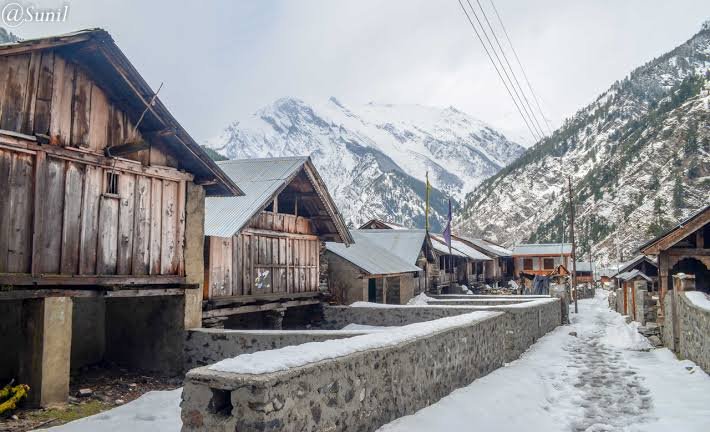
The Jad people of the upper Bhagirathi Valley brought with them an architectural tradition, a textile tradition, a culinary tradition, and a worldview that sits at the intersection of the Tibetan plateau and the Garhwali hills. Their stone and timber houses, with their distinctive low doorways and wide wooden balconies, are architectural forms shaped by cold, altitude, and the specific material intelligence of mountain people who had to build for extreme conditions with available local materials.
Walking through Bagori’s lanes is a genuinely different experience from walking through a standard Garhwali village. The architectural vocabulary is distinct. The community’s traditional costume — when worn for festivals or photographed in the hands of older residents — reflects a heritage that runs north toward Lhasa as much as it runs south toward Haridwar. The cuisine includes elements not found in the plains-influenced cooking of lower Garhwal. The festivals in the local calendar draw from both Hindu and Tibetan Buddhist traditions.
This is a village for travellers with genuine curiosity. Not for those seeking the famous, the easily photographed, or the conveniently packaged. For those who want to sit with a cup of local butter tea or sweet chai in an ancient stone house, look up at the peaks that generations of traders crossed, and feel the accumulated weight of a culture that the 21st century is only now beginning to value — this is exactly the kind of place that rewards the extra kilometre off the main road.
Quick Information at a Glance
| Detail | Information |
|---|---|
| Place Name | Bagori Village |
| Location | Bagori Village, Harsil Valley, Uttarkashi District, Uttarakhand |
| District | Uttarkashi |
| State | Uttarakhand |
| Elevation | ~2,520 metres (8,268 feet) above sea level |
| Latitude | 31.0432° N |
| Longitude | 78.7214° E |
| Nearest River | Bhagirathi |
| Nearest Town | Harsil (12–15 km) / Uttarkashi (57 km) |
| Nearest Temple | Local Jad community temple / Gangotri (37 km) |
| Nearest Airport | Jolly Grant Airport, Dehradun (215 km) |
| Nearest Railway Station | Rishikesh (245 km) / Haridwar (270 km) |
| Nearest Bus Stand | Uttarkashi–Gangotri highway (via approach road) |
| Best Time to Visit | April–June and September–November |
| Snowfall Season | December–March |
| Average Temperature | Summer: 10°C–21°C / Winter: -8°C to 5°C |
| Entry Fee | None |
| Parking | Limited roadside parking at village approach |
| ATM | None; nearest at Uttarkashi (57 km) |
| Fuel Station | Uttarkashi recommended; limited beyond |
| Medical Facilities | None; nearest at Uttarkashi |
| Mobile Network | BSNL most reliable; Jio/Airtel very limited |
| Internet Availability | Minimal |
| Google Map Coordinates | 31.0432° N, 78.7214° E |
| Emergency Contacts | Police: 01374-222233 / SDRF: 01374-222755 / Tourist: 1364 |
About Bagori Village — History, Origin, and Cultural Identity
The Jad (Bhotia) People — Who They Are
The community at Bagori belongs to the Jad people — also known as the Bhotia, a term used across the western Himalaya for communities of partly Tibetan cultural origin who historically engaged in trans-Himalayan trade. The word “Bhotia” derives from “Bhot,” an older Sanskrit-influenced term for Tibet; the Jad themselves use their own community name and have distinct cultural markers that differentiate them from other Bhotia groups in Uttarakhand (such as the Tolcha and Marchha communities of Chamoli District).
The Jad of the upper Bhagirathi Valley settled in several villages including Bagori, Harsil, and Nelong Valley — the latter now within a restricted zone close to the Tibet border. Their original homeland was the high pastures and passes of the inner Himalaya, and their traditional economy revolved around a seasonal cycle: summers spent at high altitude with their livestock and conducting trade across the passes, winters spent in lower valley villages.
The Trade Route Legacy
Bagori’s location in the Bhagirathi Valley was not accidental. The village sits on what was historically one of the significant trade corridors between the Garhwal hills and Tibet — a route that carried salt and wool from the Tibetan plateau southward and grain, spices, and manufactured goods northward. The passes above the upper Bhagirathi Valley — including the Nelang/Jadung route — were among the trade arteries that Jad traders used before the 1962 Indo-China war disrupted these movements permanently.
The closure of the Tibet border in the aftermath of the 1962 conflict fundamentally changed the economic foundations of Jad communities. Overnight, the trade that had defined their livelihoods for generations became impossible. The adjustment to a non-trade economy — agriculture, livestock, and later tourism — was significant and continues to shape the community’s economic character.
Did You Know? The Jad people of the Bhagirathi Valley are mentioned in early surveys of the Garhwal region by British administrators as a distinct community with their own language (Jadh Bhoti, a Tibeto-Burman language related to but distinct from standard Tibetan), distinctive dress, and trade specialisations.
The Name — Bagori
The name Bagori carries etymological traces consistent with Tibeto-Burman linguistic influence — the root syllables resemble place-naming conventions common to communities of Tibetan cultural background in the Himalaya. Local oral tradition associates the name with a historical figure or event connected to the village’s founding, though the specifics vary between accounts. What is consistent is that the village’s identity has been continuous in this location for many generations.
Settlement Pattern and Architecture
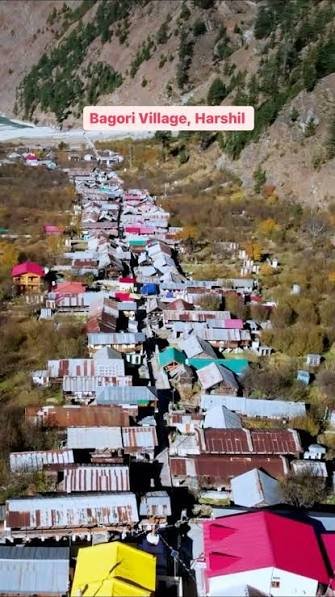
Bagori’s layout reflects the compact, defensible settlement patterns common to communities in the high Himalaya, where building close together was both socially practical and thermally efficient — shared walls reduce heat loss in environments where temperatures routinely fall well below zero. The village’s stone and timber houses are constructed using the same basic principle found in Mukhba and other traditional Garhwali villages — the koti banal technique of alternating stone and timber bands — but with distinctly Jad modifications that reflect the community’s trans-Himalayan building traditions.
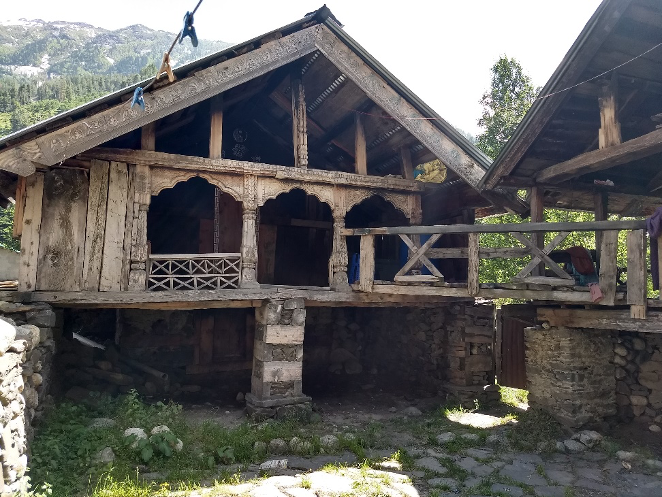
Low doorways (requiring a slight bow to enter, which some interpret as a functional response to snow load and heat retention), wide wooden balconies used for drying food, grain, and textiles, and the characteristic flat roofs (common in drier-climate Tibetan architecture, adapted here for the wetter Himalayan conditions with slight pitching) all mark Bagori’s architecture as distinct from the mainstream Garhwali tradition.
The Modern Village
Today, Bagori is a small community — a few dozen families — whose livelihoods combine agriculture (primarily apple cultivation, rajma cultivation, and small livestock), seasonal tourism employment, and in some cases, government employment and daily commuting from Uttarkashi.
The Jad language (Jadh Bhoti) is spoken within the community, though its number of active speakers is declining with each generation as Hindi becomes the primary medium of education and economic life. Several community elders are among the most knowledgeable speakers; their knowledge of the language, the traditional trade routes, and the culture represents a living heritage that the coming decades may substantially erode.
Culture and Heritage
The Jad Cultural Identity
The Jad community’s cultural identity is genuinely syncretic — it reflects centuries of interaction between the Tibetan plateau’s Buddhist traditions and the Hindu traditions of the Garhwal hills. The result is a cultural practice that contains elements of both without being fully reducible to either.
Deities and Worship: The Jad community maintains traditional local deities (devtas) alongside Hindu practice. Some families have connections to Tibetan Buddhist traditions that have persisted through generations despite geographic and political isolation from Tibet.
Festivals: The festival calendar includes participation in major Hindu festivals (Diwali, Makar Sankranti, Phool Dei) alongside traditional Jad community festivals with their own music, dance, and ritual content. The Panch Kedar pilgrimage has traditionally held importance for this community, as have local spring and harvest festivals specific to the Jad cultural calendar.
Traditional Architecture
The architectural character of Bagori’s older houses is among the most distinctive in the Harsil Valley. Features include:
- Low, heavy doorways: Typically 1.5–1.7 metres high, set within thick stone walls that provide excellent thermal mass
- Wide wooden balconies (raan): The defining visual feature of Jad houses, used for drying food, wool, and textiles in the brief summer sun
- Flat or near-flat roofs: Adapted for snow load removal and summer use as storage and sleeping areas in warm weather
- Interior hearth positioning: Centrally placed or wall-integrated hearths designed for maximum radiant heat distribution in small rooms
- Storage integration: Cleverly integrated storage areas for grain and provisions that reflect the community’s experience of extended winters
The woodwork on older Bagori houses — carved window surrounds, decorated balcony rails — shows a decorative tradition that is less flamboyant than some Garhwali ornamentation but more geometrically precise, reflecting the Tibeto-Burman aesthetic sensibility of the community’s origins.
Traditional Attire
Traditional Jad dress, while rarely worn in daily life by younger generations, is still seen at festivals and in the wardrobes of older community members. The women’s traditional dress involves layered woollen garments in dark colours with specific embroidery patterns; the men’s traditional dress includes a heavy woollen coat (chuba or similar garment) adapted for the cold climate of the upper valley.
The woollen textiles produced by Jad communities — woven on traditional looms from locally raised sheep’s wool and occasionally from other wool — are among the most distinctive craft products of this part of Uttarakhand.
Language
Jadh Bhoti is a Tibeto-Burman language related to the Tibetan language family. It is distinct from the Garhwali language spoken in the wider district and from standard Tibetan, and it represents a significant piece of India’s linguistic diversity. It is classified as an endangered language with a small number of active speakers concentrated in the upper Bhagirathi Valley communities.
For visitors interested in linguistics and endangered languages, the opportunity to hear Jadh Bhoti spoken in its home community is genuinely rare and significant.
Local Crafts
Woollen weaving is the most significant traditional craft associated with the Jad community. Hand-woven woollen carpets, blankets (dangas), and textiles represent a craft tradition of considerable sophistication. The patterns used in traditional Jad weaving have both functional and symbolic dimensions — geometric patterns that echo Tibetan carpet traditions but adapted to local aesthetic preferences and material availability.
Some families in Bagori maintain traditional looms and continue to produce woven textiles, though the scale of production has diminished significantly from its historical peak.
Agriculture
Apple cultivation arrived in the upper Bhagirathi Valley in the mid-20th century and has become the community’s primary cash crop. Bagori’s orchards produce well — the elevation and microclimate are suitable, though slightly cooler and shorter-season than the orchards at Dharali and Harsil below.
Rajma (red kidney beans) of the local mountain variety, mandua (finger millet), and jhangora (barnyard millet) continue to be grown for household use. The diversity of traditional crops maintained in the community reflects both cultural preference and the practical wisdom of food security in a location where supply chains are seasonal and unreliable.
Why Visit Bagori Village?
For cultural travellers: Bagori is one of very few accessible locations in the Garhwal Himalaya where Jad cultural heritage is visible in the built environment, in living tradition, and in the community’s daily life. This is not a heritage reconstruction — it is a living community with a specific and rare cultural identity.
For photographers: The combination of traditional architecture, mountain backdrop, orchard landscape, and community life creates photographic opportunities of exceptional quality. The geometric precision of Jad architectural detailing, in particular, rewards close observation and macro-level photography alongside landscape work.
For those interested in endangered languages: The Jadh Bhoti language community is one of India’s smaller endangered languages. The opportunity to hear it spoken is geographically limited to this area.
For slow travellers: The village’s pace is entirely its own. There are no scheduled activities, no guided tour, no admission process. You arrive, you walk, you observe, you engage with whoever is willing to engage. For those practised in slow travel, this is exactly right.
For those completing the Harsil Valley circuit: Bagori combines naturally with Harsil, Dharali, and Mukhba to form a complete exploration of the valley’s cultural and natural diversity. The four villages together represent a range from the Semwal priestly tradition of Mukhba to the Indo-Tibetan heritage of Bagori, linked by the Bhagirathi River and the apple-orchard economy they all share.
Best Time to Visit Bagori Village
Spring (April–May): Cultural Awakening
As the valley emerges from winter, Bagori’s community comes to life with the agricultural cycle. Apple blossom appears in April — white flowers against the residual snow on the peaks above. Festival activities in spring include Phool Dei, the traditional Garhwali/Jad spring festival. This is one of the most photogenic seasons and one of the least visited.
Summer (May–June): Full Season
The warmest months and the period of most reliable access. All accommodation (modest as it is) is operational. The approach road from the highway is in good condition. The surrounding landscape is deeply green, the orchards are in full leaf, and the high peaks visible from the village still carry significant snow.
Monsoon (July–August): Green Isolation
Rain is frequent. The approach road can become muddy and challenging. The landscape is exceptionally beautiful — saturated greens, waterfalls on every cliff face, dramatic cloud formations around the peaks. Very few visitors find their way here in monsoon, which for those who embrace uncertainty is part of the appeal.
Autumn (September–October): Peak Season
The finest time, without qualification. Post-monsoon clarity delivers exceptional mountain views. The apple harvest is in full swing — the orchards are laden, the community is busy with harvest activity, and the light quality in the valley is at its annual best. The cultural richness of Bagori is at its most visible when the community is engaged in the collective activity of harvest.
Winter (November–March): Quiet Season
Snow arrives progressively from November. Winters at 2,520 metres are genuinely cold (nights regularly reaching -8°C or below). Limited accommodation remains open. The road from the highway can be snow-affected. For those prepared and experienced, winter Bagori has a quality of solitude and visual beauty that makes the effort worthwhile.
Monthly Weather Table
| Month | Day Temp | Night Temp | Conditions | Crowd | Visit? |
|---|---|---|---|---|---|
| January | 0°C–7°C | -8°C to -3°C | Cold, snow possible | Nil | ⚠️ Cold, prepared only |
| February | 2°C–9°C | -6°C to -1°C | Cold, clearing late | Nil | ⚠️ Cold |
| March | 5°C–14°C | -3°C to 3°C | Warming, road improving | Very Low | ✅ Late March |
| April | 8°C–18°C | 3°C–9°C | Blossom, festivals | Low | ✅ Yes |
| May | 12°C–21°C | 7°C–13°C | Best weather | Medium | ✅ Yes |
| June | 13°C–21°C | 9°C–14°C | Warm, cloud building | Low–Medium | ✅ Yes |
| July | 12°C–18°C | 9°C–13°C | Monsoon rain | Very Low | ⚠️ Muddy |
| August | 11°C–18°C | 9°C–13°C | Rain easing, apples | Very Low | ⚠️ Caution |
| September | 8°C–18°C | 4°C–10°C | Excellent, post-monsoon | Low | ✅ Excellent |
| October | 3°C–15°C | 0°C–6°C | Harvest, clear, best | Medium | ✅ Excellent |
| November | -1°C–11°C | -4°C to 2°C | Cooling, quiet | Low | ✅ Early November |
| December | -4°C–6°C | -8°C to -2°C | Cold, snow | Nil | ⚠️ Cold |
How to Reach Bagori Village
Bagori is accessible by road from the main Uttarkashi–Gangotri highway. The village is set slightly back from the main road, reached by a side approach that branches from the highway approximately 57 km from Uttarkashi.
Distance Reference Points
| Origin | Distance to Bagori | Approx. Drive Time |
|---|---|---|
| Delhi | 475 km | 13–14 hours |
| Dehradun | 215 km | 7–7.5 hours |
| Haridwar | 255 km | 8–8.5 hours |
| Rishikesh | 240 km | 7.5–8 hours |
| Uttarkashi | 57 km | 1.5–2 hours |
| Dharali | 20 km | 35–45 minutes |
| Harsil | 12–15 km | 25–35 minutes |
| Gangotri | 37 km | 60–75 minutes |
By Road
The primary route from Delhi follows the Uttarkashi–Gangotri highway. Bagori’s approach road turns off the main highway; signage is limited, so using GPS coordinates (31.0432°N, 78.7214°E) is advised. The approach lane to the village is narrow but paved, suitable for SUVs and smaller vehicles.
Route from Delhi: Delhi → NH334B → Haridwar → Rishikesh → Devprayag → Srinagar → Rudraprayag → Tilwara → Uttarkashi → Bhatwari → Bagori turnoff
Road Conditions:
- The main highway is paved throughout; the Bagori approach lane is narrower.
- Monsoon can affect the approach lane (muddy sections, occasional minor slides).
- Winter snowfall may affect access after November.
- Fill fuel at Uttarkashi — there is no fuel station beyond.
By Shared Jeep: Shared jeeps from Rishikesh to Uttarkashi, then local jeeps toward Harsil/Gangotri. Request to be dropped at the Bagori turnoff. It is a short walk or local ride to the village from the highway junction.
By Self-Drive: Strongly recommended for flexibility. An SUV handles the approach lane and main mountain road comfortably. Plan an early start from Dehradun or Delhi to reach Bagori before dark.
Parking: Limited parking at the village entrance. Some roadside space at the highway junction. Park responsibly without blocking the narrow approach.
Things To Do in Bagori Village
Explore the Traditional Streets and Architecture
The primary activity and the reason to come. Walk the village lanes slowly. The koti banal stone-and-timber houses, the low Jad-style doorways, the wide wooden balconies — these are not maintained as a museum; they exist because the community lives in them. Approach with observation rather than intrusion, and you encounter a built environment of genuine rarity.
Look specifically for:
- Carved wooden panels on doorframes and window surrounds
- The distinctive low doorway profile of older Jad-influenced houses
- Wide balconies with drying food, wool, or textiles
- The grain storage structures elevated on stone pillars
Visit Local Temples and Shrines
Bagori has both Hindu temple structures and small community shrines associated with the Jad devta (local deity) tradition. The community temples are active places of worship. Approach with respect; remove footwear where indicated; do not photograph ritual objects without explicit permission.
Photography
Covered in detail in the Photography Guide section. The architectural detail, cultural life, and landscape setting combine to make Bagori one of the most rewarding photography destinations in Uttarkashi district.
Meet Local Artisans
Some community members continue to practice traditional woollen weaving. Ask at your homestay for introductions to weavers or craftspeople willing to meet visitors. These conversations, mediated by a Hindi speaker if necessary, are among the most valuable experiences the village offers.
Taste Traditional Cuisine
The specific food customs of the Jad community represent a culinary tradition not found elsewhere in Uttarakhand. Butter tea (similar to the Tibetan po cha — black tea churned with yak butter and salt), traditional millet breads, and specific seasonal preparations are available in homestay settings that cannot be found on any restaurant menu.
Apple Orchard Walk (August–October)
The orchards around Bagori are part of the same apple-growing landscape that defines the wider Harsil Valley. September–October harvest season gives the orchards their finest appearance. Ask at the homestay for permission to walk them.
Nature Walks
Trails from the village lead into the surrounding forest and up toward the ridge above. The forest here — deodar cedar and silver fir at the lower levels, transitioning to birch and rhododendron above — is less-visited than the forest near Harsil and rewards patient observation of birds and plants.
Sunrise and Sunset Photography
Bagori’s orientation gives good access to both morning and evening mountain light. The ridge above the village provides a viewpoint for sunrise on the Gangotri group peaks. The western view from the lower village catches the last light on the valley walls.
Bird Watching
The forest edge and orchard-forest interface around Bagori supports the same rich Himalayan bird community as the broader Harsil Valley. Himalayan monal, various pheasants, laughing thrushes, finches, and the occasional raptor. Early morning is best.
Top Nearby Attractions
Harsil (12–15 km | 25–35 minutes)
The most celebrated destination in the valley and the practical base for the region. The Bhagirathi River at its widest and most accessible, the Frederick Wilson legacy, apple orchards, and wider accommodation options. Our Harsil Travel Guide is the definitive resource.
Best Time: September–October | Ideal Duration: 1–2 days
Dharali (20 km | 35–45 minutes)
A warm, south-facing orchard village between Bagori and Harsil, with excellent apple orchards and a quieter character even than Harsil. An excellent complementary stop. Our Dharali guide covers it fully.
Best Time: September–October | Ideal Duration: Half to full day
Mukhba Village (20–22 km | 35–45 minutes via Harsil)
The winter home of Goddess Ganga and the village of the Semwal priests — a complementary cultural experience to Bagori’s Jad heritage. Together, Bagori and Mukhba represent the two major distinct cultural traditions of the upper Bhagirathi Valley. Our Mukhba Village guide is comprehensive.
Best Time: October (Bhai Dooj), April–May (Akshaya Tritiya) | Ideal Duration: Half to full day
Gangotri Temple (37 km | 60–75 minutes)
The Char Dham temple of Goddess Ganga at 3,415 metres — one of the four sacred dhams of the Char Dham Yatra. A day trip from Bagori is entirely comfortable. Our Gangotri Travel Guide covers everything.
Best Time: May–June, September–October | Ideal Duration: 1 day from Bagori
Wilson Cottage (Near Harsil, 12–15 km)
The 19th-century residence of Frederick Wilson (Pahari Wilson), the British trader-settler whose logging operations shaped the valley’s economic and ecological history.
Best Time: Any accessible season | Ideal Duration: 2 hours
Lama Top (Above Harsil area)
A ridge viewpoint above the Harsil Valley with panoramic views of the Bhagirathi corridor and the Gangotri peaks. Accessible by a 3–4 hour return trek from Harsil.
Best Time: September–October | Ideal Duration: Half day
Gangnani (40 km toward Uttarkashi | 70–80 minutes)
Natural hot springs on the Gangotri highway — thermal water with sulphur content, a traditional pilgrim rest stop. Our Gangnani guide covers the visit.
Best Time: Any accessible season | Ideal Duration: 2–3 hours
Gaumukh Trek (via Gangotri, 37 km then 19 km trek)
The Gangotri Glacier snout at 4,023 metres. Bagori makes a good acclimatisation base (2,520 m) before driving to Gangotri (3,415 m) and beginning the trek. Our Gaumukh Trek guide is essential.
Best Time: May–June, September–October | Ideal Duration: 2–3 days from Bagori
Kedartal Trek (from Uttarkashi, 57 km from Bagori)
A demanding multi-day trek to a glacial lake at the foot of Thalay Sagar. Our Kedartal Trek guide has full route detail.
Best Time: May–June, September–October | Ideal Duration: 4–5 days
Dayara Bugyal (approximately 100 km via Uttarkashi)
Uttarakhand’s finest accessible alpine meadow. An excellent extension for those spending a week in the district. Our Dayara Bugyal guide covers the full range.
Best Time: April–June, November–February | Ideal Duration: 1–2 days
Dodital Trek (from Uttarkashi area)
A beautiful lake trek through temperate forest — the legendary birthplace of Lord Ganesha. A quieter alternative or complement to the Gaumukh route. Our Dodital Trek guide.
Best Time: April–June, September–October | Ideal Duration: 3–4 days
Uttarkashi (57 km | 1.5–2 hours)
District capital with ATMs, hospital, petrol, Vishwanath Temple, Nehru Institute of Mountaineering, and all essential services. Our Uttarkashi guide is comprehensive.
Hidden Gems in and Around Bagori
The Old Village Core
The oldest section of Bagori’s built fabric — typically set back from any motor road — contains the most intact examples of traditional Jad architecture. Narrow lanes between stone walls, doorways that require a slight bow, the sound of the village rather than the highway. Finding this section requires 20 minutes of walking from the main approach; ask any local child for the direction.
The Weaver’s House
At least one family in Bagori maintains a traditional weaving loom in active use. The sound of the shuttle and the complexity of the geometric patterns being woven are both remarkable to observe. This is not a tourist demonstration — it is a craft practised by a family for whom it is part of their identity. Ask at your homestay for an introduction.
The Community Devta Shrine
The village’s local deity shrine — distinct from the main temple — is a small structure that reflects the Jad community’s pre-Hindu and syncretic religious traditions. The specific imagery and ritual objects here are different from standard Garhwali temple iconography. Approach with complete respect and request permission before photographing.
The Old Trade Path
A section of the historical trade route that passed through or near Bagori — connecting the lower valley to the higher passes toward Tibet — is still visible as a walking path above the village. Walking even a short section of it, with the awareness of centuries of traders who moved along the same stones carrying wool and salt and bartered goods, is historically significant.
Pre-Dawn Village Sounds
If you stay overnight in Bagori, the sounds of the village at 5:00 AM — when the community rises and begins its daily rhythm — are in themselves worth the journey: the deep bell of a distant cow, the crack of firewood being split, the murmur of a prayer, the river audible from the valley below. These are sounds not found in the noise-saturated environments most visitors come from.
Accommodation Guide
Bagori does not have a hotel. This is important to know before arrival and important for the right reasons: it means you cannot visit without engaging with the community.
Homestays (The Only Option in the Village)
Several families in Bagori offer homestay accommodation in their own homes. These range from very basic to quite comfortable by mountain village standards.
- Price range: ₹500–₹1,500 per night, usually including simple meals
- What to expect: A room in a traditional home — stone walls, wooden furniture, warm blankets; home-cooked Jad/Garhwali meals; the family’s company
- Booking: Through word of mouth, arrival inquiry at the village, or contact via the Uttarkashi tourism office; no central booking system exists
- Language: Hindi is the common language; English is limited
Insider Tip: The homestay experience at Bagori is the reason to come. A night in a Jad stone house, eating food prepared from the family’s own fields and orchards, in a community whose cultural identity runs back centuries — this cannot be replicated at any hotel.
Accommodation in Harsil and Dharali
For visitors who prefer more comfort or wider options, Harsil (12–15 km) and Dharali (20 km) have guesthouses and the GMVN rest house. A visit to Bagori as a day trip from either base is entirely practical. See our Harsil guide and Dharali guide for details.
For the widest district range, our Uttarkashi Hotels guide covers all price points.
Booking Tips
- Contact homestays through the Uttarkashi district tourism office or through community contacts well in advance for April–June and September–October peak periods.
- October visits near Bhai Dooj (when Mukhba receives the Gangotri idol procession) see the wider valley busier — book early for these dates.
- Winter homestay stays are possible with advance arrangement and clear communication about arrival timing.
Food Guide
Traditional Jad Cuisine
The Jad community’s food tradition is the single most distinctive culinary experience available in the Harsil Valley.
Butter Tea (similar to Tibetan Po Cha): Black tea churned with fat (traditionally yak butter, now often dairy butter) and salt. The taste is specific — savoury, warming, and rich in the way that a mountain winter demands. Many visitors find it unusual; experienced Himalayan travellers find it essential. Drinking butter tea from a Jad family’s kitchen hearth in a stone house while the mountains are visible through the window is an experience that resists summary.
Tsampa-influenced Grain Preparations: Roasted and ground barley or millet preparations, similar to the Tibetan tsampa tradition, are found in the community’s traditional food culture. These are subsistence foods that have sustained high-altitude communities for millennia and are rarely offered to visitors outside of homestay settings.
Phanu: A thick preparation from a mix of lentils and grains, slow-cooked and served as a warming winter meal. Common in various Garhwali communities but with Jad-specific variations in preparation.
Mandua ki Roti: Finger millet flatbread — standard across the upper Garhwal but with specific preparation methods in the Jad community that reflect their Central Asian-influenced culinary heritage.
Rajma Chawal: The local mountain kidney bean with rice — the universal staple of the upper Bhagirathi Valley.
Jhangora ki Kheer: Barnyard millet pudding with milk and local honey.
Fresh Apple Products: In season, fresh-pressed juice and apple preparations from the village orchards.
Tea Stalls
Bagori has minimal commercial food infrastructure. The homestay kitchen is where meals happen. A simple chai stall may operate near the village entrance during peak season.
Practical Note
Arrive at Bagori having communicated your meal requirements to the homestay in advance. The community accommodates guests generously, but it is a small village; food is prepared from what is in the kitchen and the orchard, not from a restaurant supply chain.
Shopping Guide
Handwoven Woollen Textiles: The most significant and culturally resonant purchase available at Bagori. A hand-woven woollen blanket or carpet from a Jad loom is a piece of living craft tradition — a functional object made by a maker whose cultural identity is embedded in the work.
Woollen Clothing Items: Socks, gloves, and caps knitted from local wool by village women. Practical, well-made, and warmly meaningful.
Local Rajma: The mountain kidney bean variety from Bagori’s terrace fields. A kilogram takes almost no space and makes a remarkable gift.
Mountain Honey: Forest honey from the surrounding area, occasionally available from families.
Fresh Apples (in season): Farm-gate direct purchase from orchard-owning families in August–October.
Cultural Note: When purchasing handwoven textiles or crafts directly from the maker, pay the asking price or negotiate gently and respectfully. The work represents skill and time accumulated over generations. Aggressive bargaining for genuine cultural artefacts is inappropriate and harmful.
Photography Guide
Bagori is a significant photography destination that has not yet been widely discovered by the photography travel community. This will change; visit while it is still quiet.
Best Sunrise Spots
- Ridge above the village (east-facing approach): A 20–30 minute walk above the highest house gives panoramic views of the upper Bhagirathi Valley and the Gangotri group peaks lit by alpenglow. The village’s roofline below, with peaks above, is a composition of considerable power.
- Upper orchard terrace: Looking north-east from the highest cultivated level toward the valley’s upper reaches.
Best Sunset Views
- Lower village west-facing wall: Looking down the valley, the last light illuminates the Bhagirathi corridor and the opposing cliff faces in warm tones.
- Highway viewpoint (5 minutes from village): The highway above Bagori has a natural viewpoint with good western exposure.
Traditional Architecture Photography
The carved woodwork on Bagori’s older houses — doorframes, window surrounds, balcony rails — is best photographed in the raking sidelight of early morning or late afternoon. A short telephoto or macro lens reveals detail that wide-angle shots miss entirely.
The distinctive silhouette of the low Jad doorways, with a figure either entering or standing in the threshold, is one of the most characterful portrait-architecture compositions in the Harsil Valley.
Portrait Photography
The Jad community’s older generation — particularly the women in traditional dress during festivals — are among the most dignified and visually distinctive portrait subjects in Uttarakhand. Always ask permission explicitly. Always accept refusals gracefully. The cultural weight of this community’s identity means that photography must be approached with genuine respect, not as content extraction.
Drone Regulations
The Bagori–Harsil area is near military installations in a border-sensitive zone. Drone photography requires explicit prior permission from the civil aviation authority and potentially from military authorities. Do not fly without verified clearance. This is not a guideline; it is a legal requirement with serious penalties for violation.
Camera Tips
- Altitude UV is intense. Use lens protection filters.
- Cold drains batteries faster — carry spares.
- The geometric patterns in Jad architecture reward tight, precise compositions. A 50mm or short telephoto prime lens is ideal for this subject.
- October light in this valley has a quality — warm, directional, at a low angle for most of the day — that rewards extended time with the camera.
Adventure Activities
Village Culture Walk
The primary adventure. Walking the village slowly, paying attention to architectural detail, community activity, and the specific texture of Jad material culture is the kind of engaged, attentive exploration that most adventure tourism overlooks.
Nature Trails Above the Village
Trails from the upper village enter the deodar and silver fir forest. These require no guide for the lower sections and reward with forest quiet, bird activity, and views back down into the valley.
Historical Trade Path Walk
The section of old trade route above Bagori — used by generations of Jad traders crossing toward the high passes — can be followed for 1–2 hours without technical difficulty. The historical imagination required to populate this path with loaded mule trains and traders speaking Jadh Bhoti while navigating toward Tibet makes this one of the more moving walks in the district.
Bird Watching
The forest above Bagori and the orchard-forest interface below are productive for Himalayan bird species. Himalayan monal, koklass pheasant, whistling thrush, lammergeier, and various finch and warbler species. April–May and September–October are peak seasons.
Gaumukh Trek (from Gangotri, 37 km)
Use Bagori as an acclimatisation base (2,520 m) before progressing to Gangotri (3,415 m) and the Gaumukh Trek. A night at Bagori at the right altitude before the drive up significantly reduces altitude adjustment demands.
Suggested Itineraries
Half-Day Visit (From Harsil or Uttarkashi)
- 10:00 AM: Arrive from Harsil; enter village
- 10:30 AM: Village architecture walk; temple visit
- 12:00 PM: Meet local artisan or weaver (via homestay contact)
- 1:00 PM: Traditional lunch at homestay
- 2:30 PM: Apple orchard walk or forest trail
- 4:00 PM: Depart for Harsil
Full Day Cultural Experience
- 7:00 AM: Arrive for morning light; village photography
- 9:00 AM: Breakfast at homestay
- 10:00 AM: Village walk; temple and shrine visits; meet community members
- 1:00 PM: Traditional Jad-style lunch
- 2:30 PM: Weaver visit; craft and textile documentation
- 4:30 PM: Nature trail above village; sunset photography
- 7:00 PM: Dinner at homestay; evening conversation
Two-Day Cultural Immersion
Day 1:
- Arrive late morning; check into homestay; afternoon village exploration
- Evening: Sunset photography; dinner; conversation with host family; butter tea experience
Day 2:
- Pre-dawn: Sunrise walk to ridge viewpoint
- Morning: Forest trail; bird watching
- Midday: Traditional lunch; craft shopping
- Afternoon: Visit to weaver; historical trade path walk
- Evening: Depart for Harsil or Uttarkashi
Family Tour (3–4 Days, Bagori as Part of Harsil Valley Circuit)
Day 1: Delhi to Uttarkashi (overnight) Day 2: Uttarkashi to Bagori; cultural village visit; overnight Bagori homestay Day 3: Bagori to Harsil (12–15 km); river walk; overnight Day 4: Gangotri day trip (31 km from Harsil); return; depart toward Uttarkashi
Photography Tour (4 Days)
Day 1: Reach Uttarkashi; late afternoon Gangnani hot springs Day 2: Drive to Bagori; afternoon village architecture photography; overnight Day 3: Pre-dawn ridge; morning portrait and craft photography; afternoon Mukhba Village (22 km) Day 4: Harsil valley photography; departure
Road Trip Stop
Bagori is 57 km from Uttarkashi and 37 km from Gangotri — making it an excellent midpoint stop on the Uttarkashi–Gangotri journey for those who want more than a windshield view of the valley.
Travel Budget
Budget Traveller
| Item | Estimated Cost (INR) |
|---|---|
| Shared transport (Rishikesh–Uttarkashi–Bagori area return) | ₹650–₹1,000 |
| Homestay (2 nights, with meals) | ₹1,200–₹3,000 |
| Additional food and chai | ₹200–₹400 |
| Craft purchases | ₹300–₹800 |
| Total (2 nights) | ~₹2,350–₹5,200 |
Mid-Range Traveller
| Item | Estimated Cost (INR) |
|---|---|
| Private taxi (Dehradun–Bagori area return) | ₹8,000–₹12,000 |
| Homestay + Harsil guesthouse (2 nights each) | ₹5,000–₹9,000 |
| Food and tea | ₹800–₹1,500 |
| Craft and textile purchase | ₹1,000–₹3,000 |
| Total (4 nights) | ~₹15,000–₹26,000 |
Luxury / Comfort Traveller
| Item | Estimated Cost (INR) |
|---|---|
| Private Innova from Delhi (return) | ₹18,000–₹26,000 |
| Best Harsil accommodation + Bagori homestay (3 nights) | ₹10,000–₹18,000 |
| Private cultural guide with language skills (2 days) | ₹4,000–₹7,000 |
| Premium craft purchases | ₹3,000–₹8,000 |
| Total (3 nights) | ~₹38,000–₹62,000 |
Responsible Tourism
Engage With Genuine Respect
The Jad community of Bagori has a cultural identity that predates and significantly exceeds any tourist interest in it. Arrive as a respectful guest, not a cultural consumer. The community has the right to refuse access, photography, or conversation, and these refusals are to be accepted gracefully.
Buy From the Source
Purchasing handwoven textiles, local rajma, honey, and fresh produce directly from the families who produce them channels economic benefit to the community accurately. Resist the impulse to bargain aggressively for crafts that represent skilled work.
Protect Heritage Architecture
The older houses of Bagori represent a living architectural heritage. Do not touch or lean against deteriorating structures. Do not attempt to enter private buildings without explicit invitation. Photograph respectfully — the building’s character is not improved by a tourist sitting in front of it.
No Plastic
No waste disposal infrastructure exists in Bagori. What you bring in, you carry out. This is absolute.
Respect Religious Practice
The community’s local deity shrine and temples are active religious sites. Enter only where welcome. Observe rather than participate unless explicitly invited. Do not photograph ritual objects or ceremonies without explicit permission.
Support the Language
If you have the opportunity to hear Jadh Bhoti spoken, treat it with the respect due to any endangered language. It represents a living heritage of the kind that the wider world is losing rapidly. Asking the speaker to repeat a phrase or teaching you a word is entirely appropriate — it acknowledges the language’s value.
Travel Tips
Clothing
At 2,520 metres, even summer evenings are cool. October nights are cold (near zero or below). Winters are very cold. Layer appropriately for all seasons: down jacket, thermal base layers, waterproof outer shell.
Cultural Dress
When visiting temples and community shrines, dress modestly — full-length clothing covering shoulders and knees. This is particularly important in the Jad community context where the religious sites may have specific dress expectations.
Altitude Advice
At 2,520 m, altitude effects are possible for those arriving quickly from sea level. Rest on day one, drink plenty of water, avoid alcohol. The headache of mild altitude adjustment resolves within 24 hours in most cases.
Cash
No ATMs anywhere near Bagori. Withdraw in Uttarkashi before proceeding. Carry more than you expect to need — homestay payments, craft purchases, and any unexpected expenses are all cash.
Mobile Network
BSNL is the most reliable. Other carriers are patchy to absent. Download offline maps before leaving Uttarkashi.
For Senior Citizens
The village lanes have some uneven surfaces. A walking pole is useful. The cultural richness of Bagori is entirely accessible without physical exertion beyond the village walk. A medical check is advisable before travel at this altitude for those with cardiac or respiratory conditions.
For Families with Children
Excellent for culturally curious children who can walk village lanes. The craft demonstrations and unusual architecture hold children’s attention well. Warm layers are essential. River access near Bagori should be supervised.
For Women Travelling Solo
The Jad community is generally respectful toward visitors. Arrange homestay in advance and communicate your arrival time. The community’s Indo-Tibetan heritage creates a social context that is respectful toward women — both within the community’s own traditions and in relation to guests.
For Foreign Tourists
Bagori is one of the most genuinely interesting cultural destinations for foreign tourists in Uttarakhand — the Jad Indo-Tibetan heritage, the endangered language, the traditional architecture, and the remoteness from standard tourist infrastructure create an experience that has no equivalent in more visited parts of India. Carry your passport. No special permits required for Bagori.
Interesting Facts About Bagori Village
- The Jad (Bhotia) people of Bagori speak Jadh Bhoti, a Tibeto-Burman language classified as endangered, with a community of speakers numbering in the hundreds.
- Jad traders historically crossed the high passes above the Bhagirathi Valley to reach Tibet, carrying grain, sugar, and manufactured goods northward and returning with salt, wool, and livestock.
- The 1962 Indo-China war permanently closed the trade routes that defined the Jad economy, forcing a complete economic transition from trade to agriculture within a generation.
- The Nelong Valley adjacent to the upper Bhagirathi area — now a restricted zone — was the homeland of some Jad families whose descendants now live in Bagori and other valley villages.
- The Jad community’s traditional butter tea is made with salt rather than sugar — a dietary adaptation to high-altitude caloric needs that mirrors the tea culture of Tibet.
- Bagori’s traditional houses use the koti banal construction technique in a modified form that shows Tibetan architectural influence — particularly in the low doorway heights and flat roof design.
- The Jad community’s festival calendar includes elements of both Hindu and pre-Hindu (potentially Buddhist-influenced) traditions that reflect their position at the cultural intersection of two civilisations.
- Handwoven woollen textiles from Jad communities traditionally used sheep’s wool sourced from both local flocks and traded wool from Tibet.
- The apple trees in Bagori’s orchards include some of the oldest commercial specimens in the valley — some estimated to be over 60 years old and still producing well.
- The Jadh Bhoti language, while related to Tibetan, is distinct enough that standard Tibetan speakers cannot understand it without specific exposure — reflecting the long period of geographic and cultural development in isolation.
- Some Jad families maintain oral genealogies going back many generations — accounts that trace family histories across the high passes and the seasonal migrations that defined their ancestors’ lives.
- The lammergeier (bearded vulture) — which feeds on bones and is associated in Tibetan tradition with sky burial — is seen in the mountains above Bagori, creating an unintentional cultural resonance.
- The traditional grain storage elevated on stone stilts found in Bagori predates modern pest management and reflects practical food security thinking developed over centuries.
- The Jad community’s traditional livestock — primarily sheep, goats, and yaks — supported the wool production that was both a trade good and a raw material for their weaving tradition.
- Several anthropological and linguistic studies have documented the Jad community and their language; Bagori is one of the key field sites for this research.
- The geometric patterns in Jad woollen weaving include motifs that appear in Tibetan carpet traditions and in Central Asian textile traditions, suggesting cultural connections across the trade routes.
- Bagori’s elevation (approximately 2,520 m) is at the lower boundary of the Jad community’s traditional seasonal habitation range — the upper pastures where they spent summers were at 4,000+ metres.
- The specific rajma (kidney bean) variety grown at Bagori’s altitude has been cultivated by the community for generations and is adapted to the short, cold growing season of the upper valley.
- The transition from Tibetan-rooted trade economy to Apple cultivation economy occurred primarily in the 1960s–1980s for Bagori’s families — within living memory of the current older generation.
- The oral tradition of the Jad community includes songs in Jadh Bhoti that describe the trade routes, the passes, and the seasonal migrations of the community’s ancestors.
- Bagori is mentioned in some early British administrative records of the Garhwal hills as a notable settlement of the “Bhotiyas” — the colonial-era term for communities of Tibetan cultural origin.
- The winter management of Jad houses in Bagori involves specific preparations — sealing vents, reinforcing roofs against snow load, preparing fuel stores — that reflect centuries of engineering intelligence about surviving high-altitude Himalayan winters.
- Some Bagori families maintain connections to communities in other Bhotia/Jad villages across the Himalayan arc — from Ladakh to Arunachal Pradesh — that reflects the broad geographic distribution of trans-Himalayan trading communities.
- The Himalayn monal pheasant, Uttarakhand’s state bird, is regularly seen in the forest above Bagori and holds a special place in the cultural imagination of several Himalayan communities.
- Bagori’s location slightly off the main Gangotri highway has, ironically, preserved its cultural character more effectively than villages directly on the main route that were exposed to much higher volumes of passing traffic.
Seasonal Guide — Month by Month
January: Deep winter. The village is inhabited but most guesthouses are not operating in tourist mode. Temperatures well below zero at night. The Bhagirathi is partly frozen in sections. Beautiful in a harsh, dramatic way for those prepared.
February: Gradually lightening. Snow begins melting from lower slopes by late February. The high peaks are spectacular with fresh snow. Not for general visitors.
March: The valley awakens. Snow retreats rapidly. The first cultivation activity begins. Roads improve as BRO clears winter damage. A good month for those who want the valley empty and the landscape dramatic.
April: Apple blossom season — one of the valley’s most beautiful and least-visited times. Community festivals in the Jad calendar. Good weather. This month rewards those willing to come before the main season.
May: Full season begins. All accommodation operational. Weather reliable and warm. Gangotri Temple opens. The most logistically comfortable month to visit.
June: Good weather continuing. Some afternoon cloud building. The valley is green, the orchards leafy, and the community fully engaged in their summer agricultural work.
July: Monsoon. Rain frequent. Approach road to village can be muddy. The forest and valley are extraordinary in saturated green. For those comfortable with uncertainty.
August: Apples developing on the trees. Monsoon continuing but easing by late August. Harvest preparation beginning.
September: Transformation. Monsoon gone. Sky blue. Peaks clear. Apples beginning to ripen. The community active and visually rich. A superb month to witness Jad agricultural and cultural life.
October: Apple harvest. The finest visual season. The community busy and engaged, providing natural opportunities for observation and respectful interaction. The best month for cultural photography.
November: Early November still excellent. By mid-November the valley is cooling significantly. Accommodation begins closing. The Bhai Dooj ceremony at nearby Mukhba adds cultural richness to early November.
December: Winter begins. Very cold. Limited tourist infrastructure. For those specifically interested in the winter cultural character of the village.
Common Mistakes Tourists Make
- Not arranging homestay accommodation in advance. Bagori has no hotel. If you arrive without prior arrangement, finding accommodation can be difficult. Contact through Uttarkashi tourism office or community contacts before arrival.
- Treating the village as a cultural performance. The community’s life is not staged for visitors. Observe with respect; participate only when invited.
- Attempting to buy crafts at tourist-market bargain rates. Handwoven Jad textiles are skilled craft products. The prices asked by direct makers are fair. Aggressive bargaining is disrespectful and harmful.
- Not carrying cash. No ATM exists anywhere near Bagori. Withdraw in Uttarkashi.
- Photographing people without asking. The older community members are not subjects for your travel photography without their consent. Ask explicitly; accept all answers.
- Visiting only as a quick stop. Bagori rewards time. A minimum half-day; a full day is significantly better; an overnight stay is transformative.
- Missing the early morning. The village at dawn — before the day’s activity begins — is one of its finest moments and one that no day-tripper who arrives at 10:00 AM can access.
- Not filling fuel at Uttarkashi. No fuel beyond Uttarkashi toward this area. This is non-negotiable.
- Carrying plastic bags and water bottles. No waste disposal system. Everything you bring in, you carry out.
- Coming without cultural curiosity. Bagori gives very little to those who arrive with tourist expectations of service and entertainment. It gives a great deal to those who arrive with genuine interest in the community, the architecture, the language, and the history.
Emergency Information
| Service | Contact |
|---|---|
| National Emergency | 112 |
| Police (Uttarkashi District) | 01374-222233 |
| SDRF Uttarkashi | 01374-222755 |
| Tourist Helpline (Uttarakhand) | 1364 |
| District Hospital, Uttarkashi | 01374-222026 |
| BRO Road Emergency | Via police 01374-222233 |
| Forest Department Uttarkashi | 01374-222624 |
| GMVN Helpline | 0135-2559898 |
⚠️ Medical Note: There are no medical facilities at Bagori Village. The nearest hospital is in Uttarkashi, 57 km and approximately 1.5–2 hours away. Call 112 immediately in any emergency and begin transport toward Uttarkashi. Carry a comprehensive personal first aid kit and all prescription medications for your full trip plus emergency reserves.
Conclusion
Bagori Village is not competing for your attention with Gangotri or Gaumukh or Dayara Bugyal. It does not need to. It has something those places do not: a human community with a specific, rare, and genuinely fascinating cultural identity that has persisted for centuries in one of the Himalaya’s most demanding environments.
The Jad community’s heritage — Indo-Tibetan in origin, syncretic in practice, expressed in architecture and language and weaving and food — is the kind of living culture that the world is losing faster than it is documenting or appreciating. Visiting Bagori with genuine curiosity and respectful engagement is one of the most direct ways a traveller can participate in the preservation of this heritage, by generating economic reason for the community to value what it has.
Travel with care. Carry out your plastic. Pay fair prices for craft work. Sleep in the homestay, eat the butter tea, ask about the old trade routes. Buy the rajma at the gate.
And explore the valley around you. Harsil, Dharali, and Mukhba Village complete a valley circuit that represents the most complete cultural and natural Himalayan experience available within a day’s drive of Delhi. Gangotri is 37 km away and one of the four sacred dhams of the Char Dham Yatra. The Gaumukh Trek, Dayara Bugyal, and the Kedartal Trek extend the adventure for those who want more.
Uttarkashi District repays every hour of attention you give it. Bagori is where that attention finds one of its most unexpected and rewarding returns.
Frequently Asked Questions
1. What is Bagori Village famous for? Bagori is famous for its unique Indo-Tibetan Jad (Bhotia) cultural heritage, traditional stone-and-timber architecture with distinctive low doorways and wide wooden balconies, the endangered Jadh Bhoti language, handwoven woollen textiles, and its position in the beautiful Harsil Valley of Uttarkashi District.
2. Who are the Jad people of Bagori? The Jad (also called Bhotia) are a community of Indo-Tibetan origin who historically conducted trans-Himalayan trade between the Indian subcontinent and Tibet. Their culture, language, architecture, and food reflect this heritage at the intersection of Tibetan plateau and Garhwali hill traditions.
3. What is Jadh Bhoti? Jadh Bhoti is the traditional language of the Jad community — a Tibeto-Burman language related to but distinct from standard Tibetan. It is classified as an endangered language with a small number of active speakers concentrated in the upper Bhagirathi Valley communities including Bagori.
4. How far is Bagori from Gangotri? Approximately 37 km from Bagori to Gangotri. The drive takes approximately 60–75 minutes.
5. How far is Bagori from Harsil? Approximately 12–15 km, a drive of 25–35 minutes.
6. What is the best time to visit Bagori Village? September–October is finest — apple harvest, post-monsoon clarity, and the cultural richness of harvest season. April (apple blossom) and May–June (full season) are also excellent.
7. Is there accommodation at Bagori Village? Homestays only. There is no hotel at Bagori. Several Jad community families offer rooms in their own homes, usually including home-cooked traditional meals. Book in advance through the Uttarkashi tourism office or community contacts.
8. Are there ATMs near Bagori? No. The nearest ATMs are in Uttarkashi, 57 km away. Carry all necessary cash before leaving Uttarkashi.
9. What traditional food can I find at Bagori? The Jad community’s cuisine includes butter tea (made with salt and fat, similar to Tibetan po cha), tsampa-influenced grain preparations, mandua ki roti, rajma chawal with the local mountain kidney bean variety, and jhangora ki kheer. These are available in homestay settings.
10. What is the altitude of Bagori Village? Approximately 2,520 metres (8,268 feet) above sea level.
11. Can I buy traditional Jad textiles at Bagori? Yes. Some families maintain traditional weaving looms and produce handwoven woollen textiles, including blankets, carpets, and clothing items. These are genuine craft products; pay respectful prices.
12. Is mobile network available at Bagori? BSNL has the most reliable (though still limited) coverage. Other carriers are largely absent. Do not rely on mobile internet.
13. Can foreigners visit Bagori Village? Yes. No special permit is required for Bagori. Foreign nationals should carry their passport at all times. The village is particularly interesting for foreign visitors interested in Indo-Tibetan cultural heritage and endangered languages.
14. What is the nearest hospital to Bagori? Uttarkashi, 57 km away. No medical facilities exist at Bagori. Carry a comprehensive personal first aid kit.
15. Is Bagori suitable for families? Yes, for families with culturally curious children. The village architecture, craft demonstrations, and unusual cultural context engage children well. Warm layers are essential.
16. What language do people speak in Bagori? Jadh Bhoti within the community; Hindi for external communication. English is very limited. Consider learning a few Hindi phrases before visiting.
17. Are drones allowed at Bagori? Drone flying requires explicit prior permission from civil aviation authorities and potentially military authorities due to the area’s proximity to sensitive zones near the LAC. Do not fly without verified clearance.
18. What should I wear when visiting Bagori? Modest, full-length clothing for the village and especially the temples and shrines. Warm layers are essential — even in summer, evenings are cold at 2,520 m.
19. How is Bagori different from other villages in the Harsil Valley? Bagori is the most culturally distinct village in the valley due to its Jad Indo-Tibetan heritage. Its architecture (low Jad-style doorways, flat roofs, wide balconies), language (Jadh Bhoti), food traditions (butter tea, traditional grain preparations), and craft (handwoven woollen textiles) all differ meaningfully from the standard Garhwali character of other valley villages.
20. Is there parking at Bagori Village? Limited roadside parking at the village approach. No formal parking facility. Park without blocking the narrow approach lane.
21. Can I visit Bagori in winter? Yes, but it requires preparation. The village is inhabited year-round but tourist infrastructure is minimal in winter. Temperatures fall well below zero at night. The road from the highway can be snow-affected.
22. What is the historical trade route connection of Bagori? The Jad community historically used trade routes through the upper Bhagirathi Valley to reach Tibet via high-altitude passes. These routes were used for centuries before the 1962 Indo-China war closed the Tibet border. Walking sections of the old trade path above the village provides direct connection to this history.
23. Is Bagori on the Char Dham Yatra route? Bagori is near the road to Gangotri, which is the second Char Dham. It is not itself a dham but is an integral cultural stop for those doing the full Char Dham Yatra or the Gangotri section.
24. How do I reach Bagori from Delhi? Drive via Haridwar → Rishikesh → Devprayag → Uttarkashi → Bhatwari → Bagori turnoff (approximately 475 km, 13–14 hours). An overnight stop at Rishikesh or Uttarkashi is recommended.
25. Is Bagori suitable for solo travellers? Yes, particularly for those interested in cultural travel. Solo travellers may find the homestay context ideal — the one-on-one engagement with a host family is enriched when there is only one guest. Standard sensible precautions apply.
26. What makes Bagori special compared to Mukhba Village? Both are culturally significant Harsil Valley villages, but their significance is different. Mukhba’s identity is defined by the Semwal priestly tradition and its role as winter home of the Gangotri deity. Bagori’s identity is defined by its Jad Indo-Tibetan heritage — different architecture, different language, different food traditions, different cultural history.
27. What wildlife can I see near Bagori? Himalayan monal, koklass pheasant, various laughing thrushes, lammergeier vulture, plumbeous and blue-capped redstart, and various finch species. The forest above the village is the best habitat.
28. Are traditional festivals celebrated at Bagori? Yes. The community observes both standard Hindu festivals and Jad-specific community festivals with traditional music and dance. The spring and harvest periods are the most active festival times.
29. What is the significance of the handwoven textiles from Bagori? Jad woollen textiles are both functional objects and cultural artefacts — the geometric patterns in traditional weaving reflect a heritage that connects the community to Tibetan carpet traditions and Central Asian textile history. Purchasing directly from a maker is an act of cultural support.
30. Is Bagori worth visiting for just a few hours? A brief stop reveals the architectural character and gives a first impression of the village. However, the cultural depth of Bagori — particularly the opportunity to engage with the Jad community, taste traditional food, and observe craft practice — requires at minimum a full day, and is significantly enriched by an overnight homestay stay.
