
Vasuki Tal Trek via Tapovan – The Lake the Glaciers Keep to Themselves
Vasuki Tal Trek | Tapovan Trek Uttarakhand | Best treks in Gangotri | Glacier treks in Uttarakhand
At the Edge of the World the Maps Forget to Label
There is a lake in the upper Gangotri Himalaya that sits at over 5,200 metres in a glaciated basin so remote that most trekkers who know the Gangotri valley well have never been within twenty kilometres of it. It is not a secret exactly — those who move in serious Himalayan trekking circles know its name — but it is private in the way that only genuinely difficult terrain can make a place private. You cannot arrive at Vasuki Tal accidentally or casually. The glacier and the altitude and the technical demands of the approach see to that.
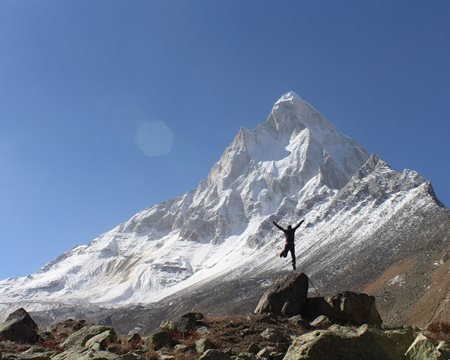
The Vasuki Tal Trek via Tapovan is the route that takes you there — through the sacred Gangotri valley, past the snout of the Gangotri Glacier at Gaumukh, up the steep headwall to the legendary Tapovan meadows where Shivling rises overhead like an architectural argument for the existence of mountains, and then further, deeper, higher into the glacier basin where the lake sits in its extraordinary isolation. This is Himalayan expeditions Uttarkashi at the outer edge of what non-technical trekkers can responsibly attempt — a route that demands previous experience, proper gear, and genuine physical preparation, and that gives back, in exchange, access to landscapes that most people who love mountains will spend their entire lives not seeing.
The journey combines three of the most significant environments in the Indian Himalaya: the sacred pilgrimage geography of the Gangotri valley, the legendary beauty of Tapovan, and the austere, ice-ringed world of the high glacier basin. For those ready for it, the Vasuki Tal Trek is among the finest things the Uttarkashi Himalaya offers.
Trek Overview: The Route and Its Demands
The Vasuki Tal Trek via Tapovan begins at Gangotri Temple and moves progressively deeper into the Gangotri National Park wilderness, gaining altitude in a sustained arc from the sacred town at 3,048 metres to the lake at approximately 5,200 metres.
Essential figures:
- Vasuki Tal Altitude: ~5,200–5,291 metres
- Starting Point: Gangotri Temple (~3,048 metres)
- Duration: 8–10 days (approach, acclimatisation, lake visit, return)
- Total Distance: ~55–65 kilometres return
- Difficulty: Advanced — suitable for experienced high-altitude trekkers with prior glacier exposure
- Glacier Sections: Yes — Gaumukh Glacier approach and upper glacier terrain to the lake
- Tapovan Altitude: ~4,463 metres
- Technical Requirements: Crampons and ice axe recommended for upper sections; basic glacier travel competence essential
The route’s appeal to serious trekkers operates on multiple levels simultaneously. This is not a trek with a single defining objective — the journey through the Bhagirathi valley, the Gaumukh Glacier crossing, the extraordinary Tapovan camp, and the final approach to the lake each constitute significant Himalayan experiences in their own right. The combination is what makes the Vasuki Tal Trek exceptional even within the already exceptional best treks in Gangotri category.
A note on what this trek requires: the section between Tapovan and Vasuki Tal moves through high-altitude glacier terrain that demands the full technical kit and the knowledge to use it. The lake is not accessible to trekkers who have not previously spent time on glaciers with crampons. If that experience is not yet in the background, the Tapovan section of this route — itself one of the finest destinations in the Indian Himalaya — is the appropriate objective until it is.
Sacred Ground: The Mythology Written Into the Landscape
The Vasuki Tal Trek moves through terrain that Hindu mythology and Himalayan spiritual tradition have understood as sacred for as long as recorded texts exist. Understanding this geography does not require religious belief — but it enriches the experience of the trek in ways that purely athletic framing cannot account for.
Vasuki is the name of the great serpent that Lord Shiva wears coiled around his neck in the iconographic tradition — a being of immense cosmic significance in Hindu cosmology, the king of the nagas, who participates in the churning of the celestial ocean in one of the most consequential stories in the Puranas. The lake that bears his name is understood in the sacred geography of the Gangotri region as a place of Shiva’s presence — remote, cold, austere, and profound in the way that genuinely sacred places in the Himalaya tend to be.
Tapovan — the meadow that serves as the route’s mid-point camp and one of its defining environments — translates as “forest of austerity,” a name that reflects its historic use as a retreat ground for sages and ascetics who came to the upper Gangotri valley specifically because its remoteness and its sacred character provided the conditions for deep spiritual practice. The resident sadhus who have maintained camps at Tapovan over the decades embody a continuity with this tradition that is striking in its longevity. The meadow feels inhabited by this history — not in a museum sense, but in the living sense of a tradition that continues.
The Gangotri glacier trek approach via Gaumukh adds another layer of sacred geography: the glacier is the physical source of the Bhagirathi River, which becomes the Ganga downstream. Walking on this ice is walking on the origin of the most sacred river in India — a fact whose weight is not diminished by the geological explanation of how glaciers work.
The Gangotri trekking guide experience here is inseparable from this mythological dimension. Approach it as context rather than spectacle, and the mountains respond in kind.
What the Eyes Carry Back
The visual language of the Vasuki Tal Trek via Tapovan is unlike anything accessible in the lower Himalaya. It is an accumulation of specific images that tend to persist:
Shivling from Tapovan at dusk. The peak in its last light above the darkening meadow, its colour shifting from gold to rose to the grey-blue of deep shadow, is an image that photographers have pursued for decades and that no photograph quite captures.
The Gaumukh ice wall. Forty metres of glacier terminus in the morning light, blue-green where the ice is deep, white where the surface scatters the light, constantly melting into the river below.
The high glacier in pre-dawn. Moving across the ice toward Vasuki Tal before first light, the headlamps creating small circles of visibility in the absolute dark, the crampons sounding sharp against the ice surface, the silence everywhere else.
The lake. That specific blue, that specific silence, those specific walls of ice and rock. There is no equivalent.
What This Trek Requires: Honest Preparation
Experience: Prior high-altitude trekking above 4,500 metres is the baseline. Glacier travel with crampons and ice axe — even a single previous glacier crossing — is strongly preferred. The Nehru Institute of Mountaineering in Uttarkashi offers basic mountaineering courses that specifically prepare trekkers for this kind of terrain; their location makes them the natural preparation point for any serious Gangotri valley objective.
Physical preparation: The six days of sustained altitude and gradient between Gangotri and Vasuki Tal and back require cardiovascular fitness that cannot be improvised. Build specifically for the expedition in the months preceding it.
Complete gear kit: High-altitude trekking boots with crampon compatibility, 10-12 point crampons, ice axe, trekking poles, UV-protective glacier glasses (not optional at these elevations — snow blindness at 5,000 metres is a real and serious condition), layering system from +15°C to -20°C, four-season sleeping bag. Everything on this list is load-bearing, not luxury.
Permits: Gangotri National Park entry at the check post before the trail begins. Confirm any additional permit requirements for the upper glacier zone with the Forest Department or your guide before departure.
The Wider Geography: What Surrounds This Trek
Gangotri Temple anchors the entire sacred geography of this expedition — the departure point and the return point, whose significance deepens on the last day in ways it cannot on the first.
Gaumukh Glacier is both a transit point on this route and a destination in its own right — the largest glacier in the Indian subcontinent outside the Karakoram, and the physical source of the Bhagirathi River.
Tapovan warrants its reputation as one of the finest Himalayan camps accessible to non-technical trekkers. Even without the Vasuki Tal extension, it is a journey worth making.
Harsil Valley and Mukhba Village lower in the Bhagirathi drainage provide the cultural and pastoral contrast — approachable before or after the expedition as a way of engaging with the inhabited, Garhwali dimension of the landscape.
Kedar Tal Trek — north of Gangotri, accessing a different high-altitude lake through similarly demanding terrain — is the natural companion objective for those building a serious Uttarkashi trekking programme.
What Kashi of North Offers This Expedition
KashiOfNorth.com exists at the intersection of local knowledge and serious Himalayan adventure. The Vasuki Tal Trek via Tapovan is precisely the kind of route the platform was built to support — remote, demanding, spiritually resonant, and completely dependent on the quality of the local knowledge and guide relationships that only genuine familiarity with the Uttarkashi landscape provides.
Adventure tourism Uttarakhand of this calibre requires more than a route description. It requires current conditions intelligence, guide contacts with specific experience on the glacier terrain above Tapovan, permit guidance, and the cultural context that makes the sacred geography of the Gangotri valley more than a scenic backdrop. Kashi of North provides all of it.
Before the First Step
- Acclimatise fully at Gangotri and Bhojbasa. Rushing the altitude gain on this route is the single most common cause of expedition failure and the most preventable. The schedule must serve the physiology, not the other way around.
- Travel with a guide who has been to Vasuki Tal. The upper glacier terrain above Tapovan changes from season to season. A guide with recent first-hand knowledge of the route is the expedition’s most important safety system.
- Carry complete glacier kit and know how to use it. Crampons and ice axe are required equipment above Gaumukh. Arrive knowing how to use them, not planning to learn on the glacier.
- Start every day early. Pre-dawn starts give the team the stable early-morning weather window, the best snow conditions on the glacier sections, and the time buffer that keeps a difficult day manageable and a long day safe.
- Leave zero trace in the high terrain. The glacier basin around Vasuki Tal is among the most fragile high-altitude ecosystems in India. Everything carried up comes down. Every campsite is left exactly as it was found. This is not an aspiration — it is the minimum standard of conduct for this terrain.
- Respect the sacred geography. This is active pilgrimage territory as well as a national park and an expedition environment. The combination of these dimensions is what makes the Gangotri valley unique in India. Hold all three with appropriate care.
Vasuki Tal does not reveal itself to the uncommitted. It asks something real of those who come, and it gives something real in return — a place in the Himalaya so remote, so beautiful, and so complete in its own terms that it tends to recalibrate what other landscapes are capable of feeling like afterward.
Discover the full spectrum of advanced glacier treks and Himalayan expeditions in Uttarkashi at kashiofnorth.com