
🛕 Temple
· Uttarkashi Town
Kashi Vishwanath Temple Uttarkashi: The Spiritual Heart of the Kashi of the North
The Kashi Vishwanath Temple in Uttarkashi sits on the banks of the Bhagirathi River, dedicated to Lord Shiva in his form as Vishwanath — Lord of the Universe — the same divine form worshipped at the more famous Kashi Vishwanath Temple in Varanasi. Kashi Vishwanath Temple Uttarkashi is the reason the town carries its name at all: Uttarkashi translates to “Kashi of the North,” a direct homage to Varanasi, and this temple is the axis around which that identity — and much of the town’s daily life — has turned for centuries.
For travelers heading toward Gangotri or the high trekking routes above the Bhagirathi valley, this temple is often the first and final stop of the journey — the place that sets the spiritual tone for everything that follows. This guide covers its history, mythology, architecture, the famous ancient Trishul beside it, daily aarti timings, festivals, and more than 40 answered questions.
Kashi Vishwanath Temple, Where the Mountains Bow to lord Shiva
Kashi Vishwanath Temple is one of Uttarakhand’s most sacred Shiva temples, standing on the banks of the Bhagirathi River in Uttarkashi town and housing a self-manifested (Swayambhu) Shiva lingam worshipped as Vishwanath, Lord of the Universe.
This is not simply one of several temples in Uttarkashi — it’s the reason Uttarkashi exists as a pilgrimage town at all. Long before modern roads and trekkers arrived, this temple was the axis around which valley life turned, and the town’s very name honors it: Uttarkashi, the “Kashi of the North,” a direct homage to Varanasi (Kashi) on the banks of the Ganga. For pilgrims traveling the Char Dham route toward Gangotri, the temple is often the natural first and final stop of the journey.

History of Kashi Vishwanath Temple
Local tradition holds that Sage Parshuram originally installed the temple, with recorded history noting that Maharani Khaneti, wife of Sudarshan Shah, renovated the structure in 1857 — the current temple stands over this earlier altar in traditional Himalayan architectural style.
The following blends documented history with local and scriptural tradition — the distinction matters, and readers should treat each accordingly.
Hindu scripture and local tradition both describe Uttarkashi as a site of deep sacred power well before it became a formal waypoint on the Char Dham circuit. Ancient belief holds that Uttarkashi carries the same spiritual energy as Varanasi, but at a higher, purer Himalayan elevation — as though Shiva’s city had been lifted into the mountains for those willing to seek it out. The temple has been rebuilt and restored across centuries, shaped by the patronage of Garhwali rulers and the devotion of the pilgrims who understood its roots ran deeper than any single structure. According to belief, Lord Vishwanath has considered this his abode since the second part of Kalyuga, and devotees hold that Lord Kashi Vishwanath will relocate here should Varanasi itself ever be submerged — a belief that speaks to how seriously the “northern Kashi” identity is taken locally, rather than treating it as a mere naming convenience.
Why Is Uttarkashi Called the Kashi of the North?
Uttarkashi earns its name through a genuine geographic and spiritual parallel with Varanasi — both towns sit on a river treated as the sacred Ganga, both are framed by two smaller rivers named Varuna and Asi, both have a Manikarnika Ghat, and both are anchored by a Vishwanath temple to Shiva.
In Uttarkashi, the Bhagirathi plays the role the Ganga itself plays in Varanasi. The Kaligad (locally the Asi) and the Syalam Gad (locally the Varuna) frame the town the same way Varanasi’s Asi and Varuna rivers do, and Uttarkashi’s own Manikarnika Ghat mirrors the famous cremation ghat in Varanasi by name and function. This isn’t a modern marketing parallel — it’s a genuine topographical echo that has shaped how pilgrims have treated this town for centuries, giving Uttarkashi a claim to the “Kashi of the North” title that goes well beyond simple wordplay.
Religious Importance: A Temple at the Crossroads of Everything Sacred
Lord Shiva’s presence at this temple is understood by devotees to be immediate and potent. Worship here centers on darshan — the sacred act of simply being in the divine gaze — rather than spectacle, and the temple’s position on the road to Gangotri means nearly every serious Char Dham pilgrim passes through it. For many devotees, a stop here isn’t a detour from the yatra; it’s part of the yatra itself, the place where spiritual intention for the journey ahead is first set.
According to belief, true devotion and service at this temple leads toward moksha (liberation), and tradition holds that Lord Shiva himself whispers the mantra of salvation into the ears of those who die naturally within the temple’s presence — a belief that underscores why this shrine carries such weight in the wider geography of Uttarakhand’s sacred sites.
Mythology
The following presents religious tradition and Puranic reference as believed and preserved — devotional narrative, not verified history.
According to mythology, Lord Shiva himself protected Rishi Markandeya from Lord Yama, the god of death — a story tied to this temple’s tradition, and the complex includes an image of Sakshi Maharaj and Rishi Markandeya in meditative posture. Broader Puranic references, including sections of the Kedar Khand within the Skanda Purana, are understood locally to speak to the sacred character of this Bhagirathi valley landscape, of which the Vishwanath Temple is the devotional center. As with all such tradition, these accounts should be understood as scripture and local folklore rather than documented historical fact.
Temple Architecture
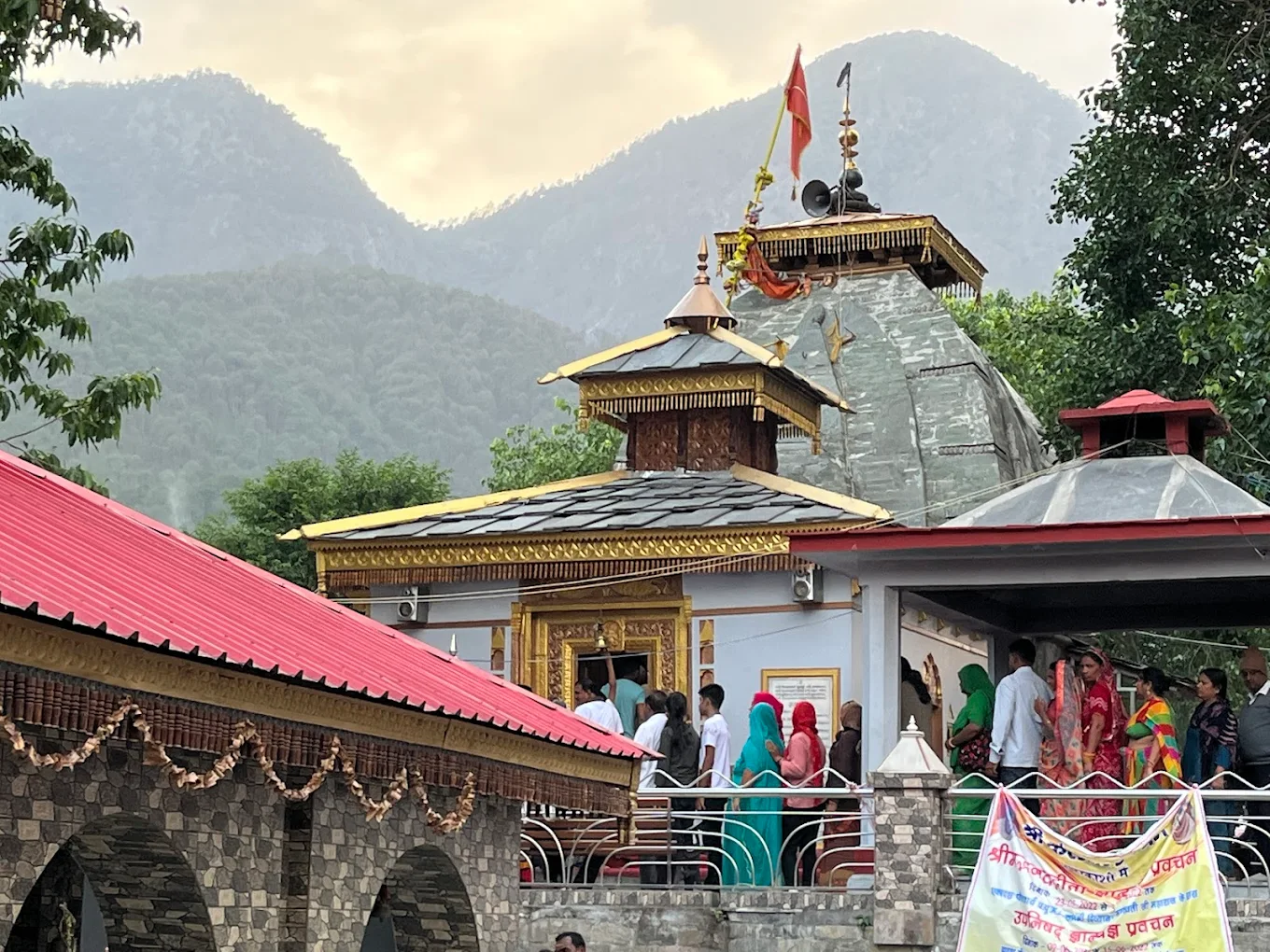
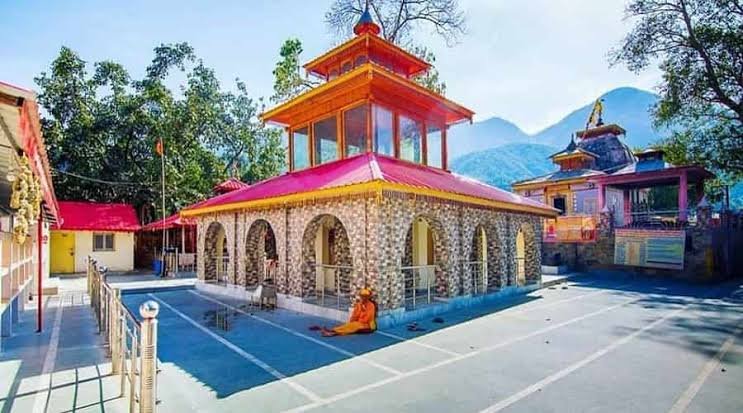
The temple follows traditional Himalayan stone architecture with clear North Indian Nagara influence — a tall, tapering shikhara (spire) rising above the sanctum, its form meant to evoke Mount Meru, the cosmic mountain of Hindu cosmology. Construction uses the grey stone characteristic of Himalayan sacred architecture, drawn from the surrounding mountains themselves, giving the structure a sense of having grown from the landscape rather than simply being built on it.
Inside, the atmosphere shifts noticeably — the stone stays cool even in summer, light is dim and focused, and the sanctum holds the Shiva lingam that devotees have circumambulated with the same prayers for generations. The temple complex also includes smaller shrines and a ghat atmosphere connecting the sacred architecture directly to the flowing Bhagirathi below — in Uttarkashi, the river and the temple are treated as inseparable parts of the same spiritual landscape.
The Famous Trishul
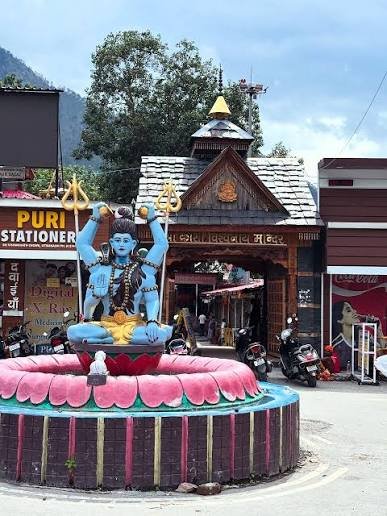
Just beside the temple complex stands an enormous, ancient Trishul — Shiva’s trident — believed locally to be over 1,500 years old and roughly 6 meters in height, one of the temple precinct’s most striking and distinctive features.
Local tradition holds this Trishul carries deep mythological significance, with some accounts associating it with cosmic battles described in Hindu scripture. Visitors consistently note a specific, often-repeated local claim: that the Trishul cannot be moved by full-body force, yet is said to vibrate in response to a single finger’s pressure. This guide presents that claim as it’s commonly reported by visitors and local tradition — it isn’t independently verified, and readers should treat it as part of the site’s living folklore rather than a scientifically confirmed phenomenon. Regardless of how one approaches that specific claim, the Trishul itself commands genuine attention as a physical marker of the devotional intensity concentrated at this site.
The Main Shrine
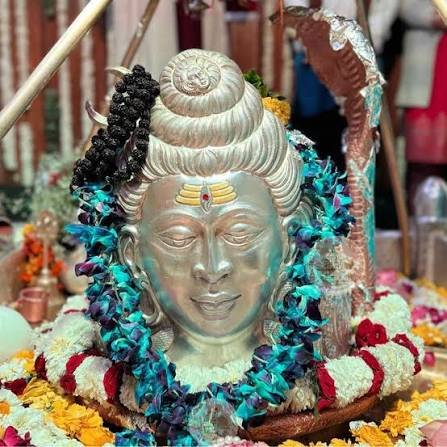
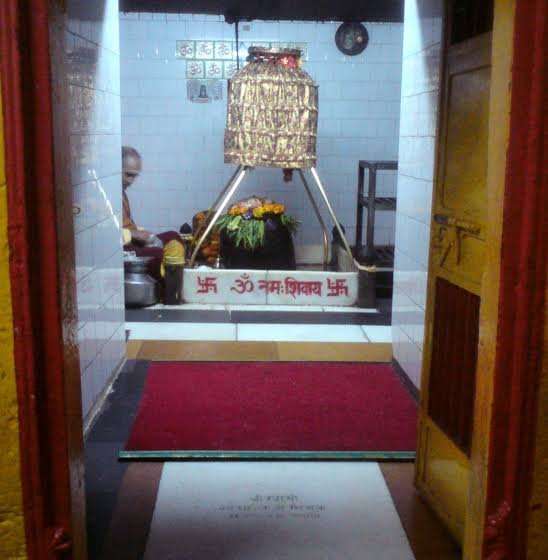
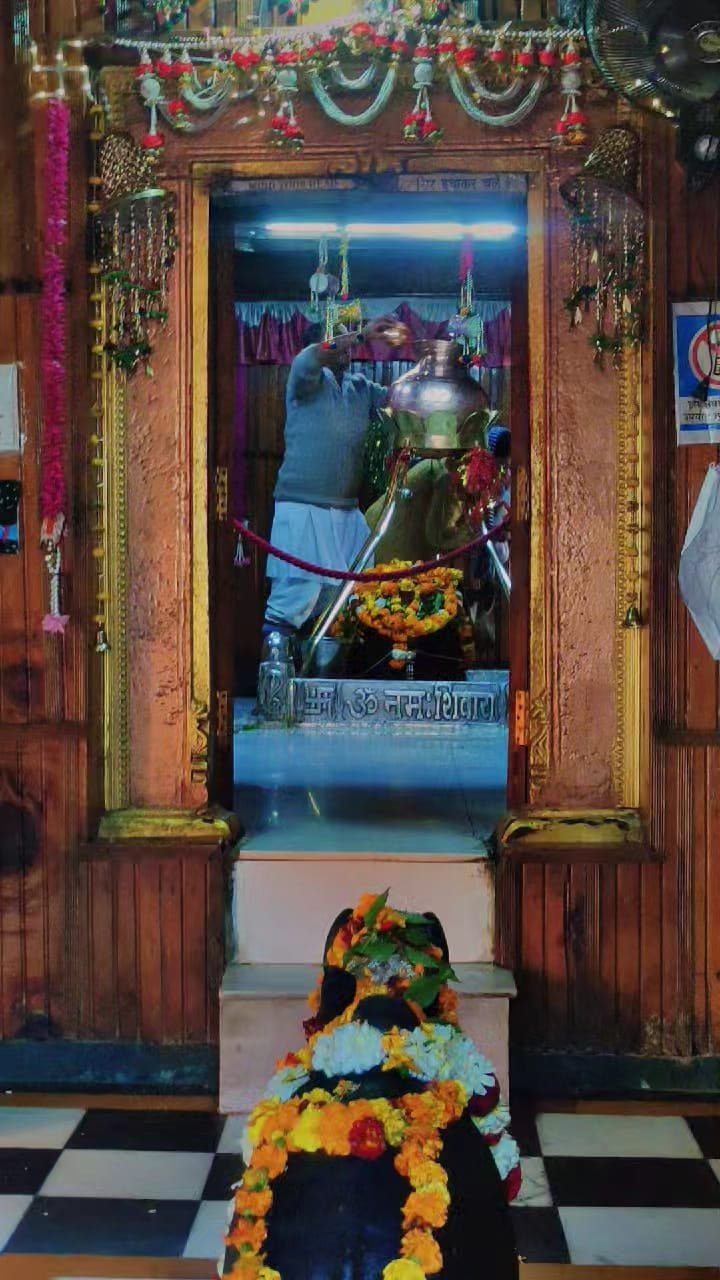
The sanctum sanctorum houses a self-manifested (Swayambhu) Shiva lingam, reported at approximately 56 cm in height and tilted toward the south, alongside images of Goddess Parvati and Lord Ganesha, with Nandi positioned in the outer chamber.
The Swayambhu nature of the lingam — understood as self-manifested rather than installed — is central to the temple’s devotional significance, distinguishing it from consecrated lingams found elsewhere. Darshan here follows the same essential pattern as at Shiva temples across India: approaching the sanctum with reverence, offering prayers, and receiving the sight of the deity as a form of grace.
Directly across from the Vishwanath Temple stands the Shakti Temple, dedicated to Goddess Parvati and centered on the same striking Trishul described above. Together, the Vishwanath and Shakti temples form the devotional heart of Uttarkashi — Shiva and Shakti traditions existing side by side, and many pilgrims visit both in the same morning to complete a fuller experience of the town’s sacred character.
Daily Rituals and Aarti Timings
The temple follows a structured daily ritual schedule, from a pre-dawn Mangala Aarti through the night’s closing Shayana Aarti — though all timings should be verified locally before your visit, since schedules can shift with the temple administration and Hindu calendar.
| Aarti | Approximate Timing |
|---|---|
| Mangala Aarti | 3:00 AM – 4:00 AM |
| Bhoga Aarti | 11:15 AM – 12:20 PM |
| Sandhya Aarti | 7:00 PM – 8:15 PM |
| Shringara Aarti | 9:00 PM – 10:15 PM |
| Shayana Aarti | 10:30 PM – 11:00 PM |
General temple/darshan hours run approximately 6:00 AM to 8:00 PM. Rudrabhishek and Jal Abhishek rituals, particularly significant during Shravan month and Maha Shivaratri, are also performed — check current schedules and any special puja bookings with the temple or a local guide ahead of your visit.
Want your visit timed around a specific aarti or special puja? Kashi of North can confirm current schedules and arrange your itinerary accordingly — WhatsApp +91 7253079221.
Festivals
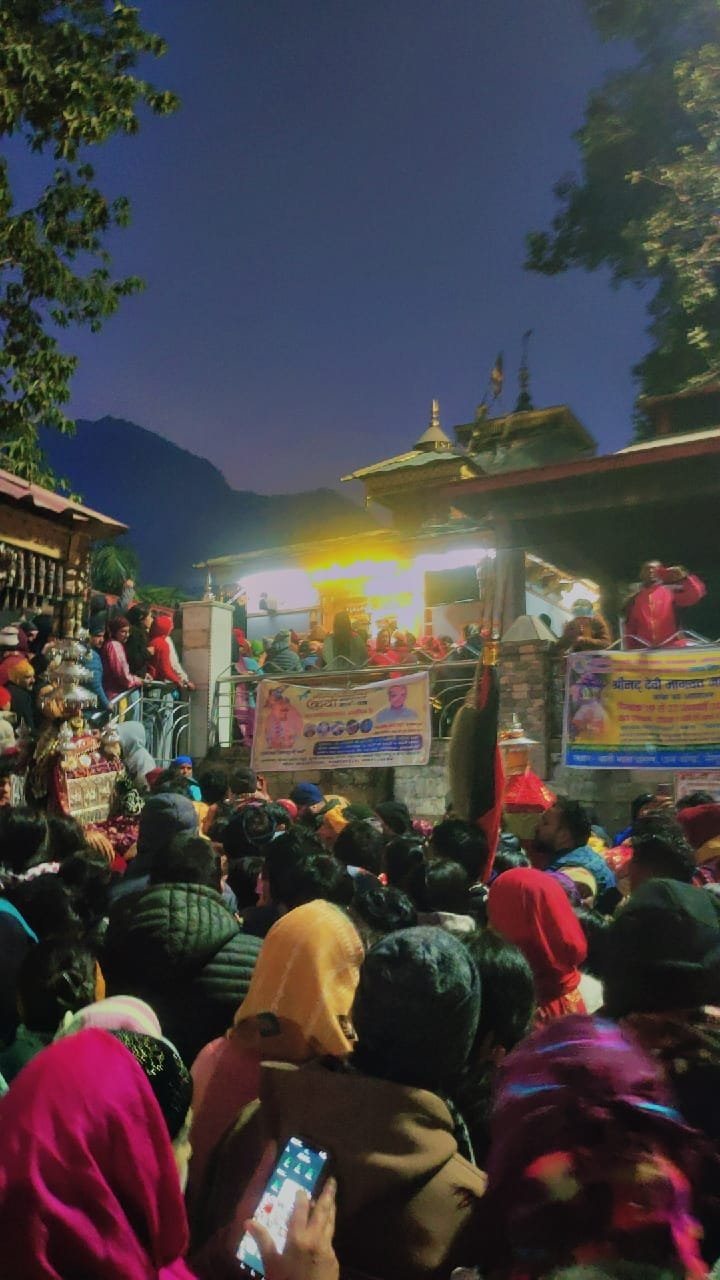
Maha Shivaratri and the Magh Mela are the temple’s two most significant annual observances. During Maha Shivaratri, priests wash the Shivalinga every three hours with cow’s milk, curd, honey, ghee, and water, devotees decorate the lingam with flowers and conduct milk abhishek, women pray for the wellbeing of their husbands and children, and unmarried girls observe fasts seeking a good and understanding future husband.
The Magh Mela, held on Makar Sankranti in the Hindu month of Magh, includes traditional cultural activities such as a procession carrying dolls to the Vishwanath Temple, alongside devotees taking a holy dip in the Bhagirathi. Special puja is also observed on other significant dates through the year — verify the current festival calendar with the temple or a local guide, since exact dates follow the Hindu lunar calendar and shift annually.
Temple Experience
Early mornings and evenings are when this temple is most itself — the sound of bells and chants blending naturally with cold mountain air, the crowds thin, and a quality of stillness that even secular travelers tend to remember long after the trip ends. The temple’s simplicity is part of its character: rituals here are performed with devotion rather than display, and the connection between the shrine and the Bhagirathi flowing just below is felt rather than merely observed. Nearby, Uttarkashi’s small streets, traditional homes, and local markets create an atmosphere where spiritual life and everyday living blend without much separation — a slower pace than larger pilgrimage cities offer.
Why Visit Kashi Vishwanath Temple?
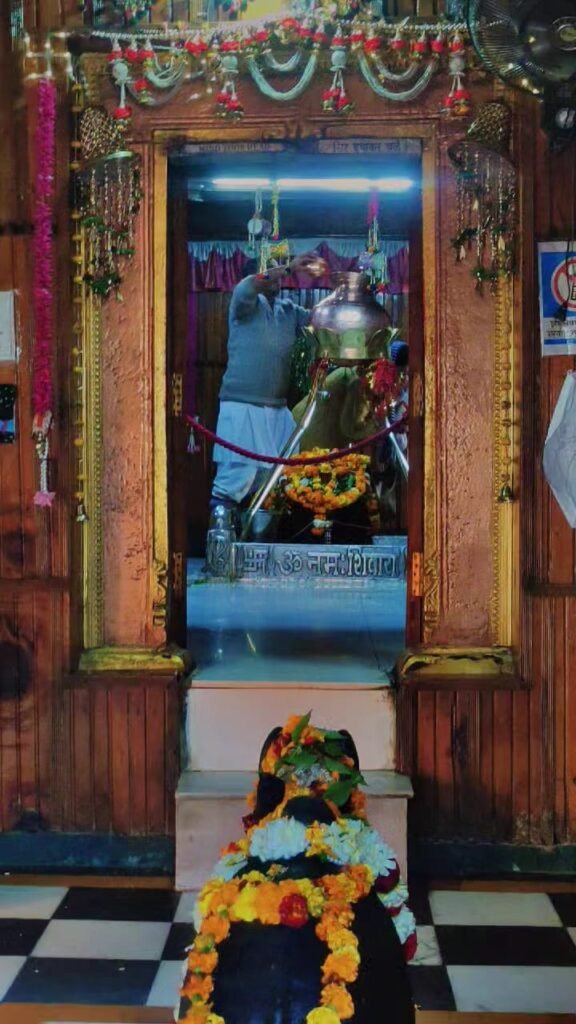
Beyond its central religious significance, the temple offers genuine architectural and historical interest — Himalayan stone construction, the ancient Trishul, and a lineage that local tradition traces back through Sage Parshuram and documented 19th-century restoration. For photographers and cultural travelers, the temple, the Shakti Temple across from it, and the Bhagirathi ghats together form one of the most photogenic and atmospheric religious complexes in the district. And for anyone undertaking the Char Dham journey toward Gangotri, a stop here isn’t optional in any meaningful spiritual sense — it’s where the intention for the rest of the pilgrimage is set.
Planning to visit Kashi Vishwanath Temple as part of a wider Char Dham or Gangotri trip? Kashi of North designs full pilgrimage itineraries — call or WhatsApp +91 7253079221.

Nearby Attractions
| Place | Distance | Notes |
|---|---|---|
| Shakti Temple | Directly across from Vishwanath Temple | Same devotional complex, famous Trishul |
| Manikarnika Ghat | Within Uttarkashi town | Bhagirathi riverside ghat, mirrors Varanasi’s ghat |
| Maneri Dam | Short drive from town | Dramatic gorge, turquoise reservoir water |
| Nehru Institute of Mountaineering | Within Uttarkashi town | Mountaineering history and museum |
| Gangnani | ~48 km | Hot spring stop on the Gangotri Highway |
| Harsil Valley | ~78 km | Apple orchard valley on the Bhagirathi |
| Gangotri Temple | ~100 km | Char Dham temple, source of the Ganga |
| Dayara Bugyal | Via Bhatwari | Alpine meadow trek |
Want to combine the temple visit with Maneri Dam, the Shakti Temple, and a Gangotri excursion in one trip? Kashi of North plans the full itinerary — WhatsApp +91 7253079221.
Best Time to Visit
March–June and September–November offer the most comfortable weather for visiting Kashi Vishwanath Temple, while winter brings a quieter, more contemplative atmosphere and monsoon brings lush greenery alongside travel uncertainty.
Summer (April–June): Widely regarded as the most comfortable and practical season — warm days, cool evenings, clear skies, and reliable roads from Rishikesh and Dehradun. If combining the visit with Char Dham preparations, this is the practical choice.
Monsoon (July–September): The valley turns intensely green, mist moves through the cedars in early morning, and the Bhagirathi swells with real force — genuinely beautiful, but mountain roads can be unpredictable and landslides are a real consideration. Check road conditions daily and build flexibility into your itinerary.
Winter (October–February): Uttarkashi receives snow from December onward, and the temple in snow carries a genuinely otherworldly quality — deeper mountain silence, thinner crowds, and a more contemplative visit than any other season offers. Carry serious cold-weather gear, and note that roads to Gangotri (closed seasonally regardless) will be inaccessible.
Photography Guide
The temple exterior and the ancient Trishul are best photographed in early morning or late afternoon light, when the stone architecture takes on warm tones against the mountain backdrop. The Bhagirathi ghats and Manikarnika Ghat offer strong river-and-temple compositions, particularly around aarti times when lamplight adds atmosphere. Festival photography — especially during Maha Shivaratri and Magh Mela — captures the temple at its most visually vibrant, though always with respect for devotees engaged in worship. Photography inside the sanctum sanctorum is generally not permitted — verify current rules locally before attempting any interior shots, and always ask permission before photographing individual worshippers.
How to Reach
Uttarkashi is well-connected to Uttarakhand’s gateway cities by road, with the journey itself — a winding ascent through river valleys and forested ridges — forming part of the pilgrimage experience.
By Road:
- From Dehradun: Approximately 155 km via the Rishikesh–Uttarkashi highway (NH-134), passing through Chamba and the Tehri reservoir — typically 5–6 hours depending on road and traffic conditions.
- From Rishikesh: Roughly 170 km, around 6–7 hours by road, with shared jeeps, private taxis, and state buses operating regularly, particularly during Char Dham season. The route follows the Bhagirathi and then the Ganga.
- From Gangotri: Roughly 100 km back down the valley.
By Air: The nearest airport is Jolly Grant Airport, Dehradun, roughly 155–171 km from the temple.
By Train: The nearest railway stations are Rishikesh and Haridwar, with Haridwar offering broader connectivity.
Prefer not to navigate the drive yourself? Kashi of North provides private taxi service from Dehradun, Rishikesh, or Haridwar to Uttarkashi — WhatsApp +91 7253079221.
Distance Chart
| Origin | Distance | Approx. Time |
|---|---|---|
| Delhi | ~440–460 km | 11–13 hours |
| Haridwar | ~165–180 km | 6–7 hours |
| Rishikesh | ~170 km | 6–7 hours |
| Dehradun | ~155 km | 5–6 hours |
| Gangotri | ~100 km | 3–3.5 hours |
| Harsil | ~78 km | 2.5–3 hours |
| Gangnani | ~48 km | 1.5–2 hours |
| Bhatwari | ~30 km | 45–60 minutes |
Accommodation
Uttarkashi offers accommodation across every category, from simple dharamshalas suited to pilgrims to mid-range and better hotels with modern amenities.
| Category | Type | Notes |
|---|---|---|
| Budget | Dharamshalas, basic guesthouses | Simple, pilgrim-oriented |
| Mid-range | Standard hotels | Attached bathrooms, basic amenities |
| Better | Hotels with added facilities | Front desk service, Wi-Fi, in-room amenities |
Carry valid government ID (such as an Aadhaar card), which is required at check-in for hotel bookings in Uttarkashi as elsewhere in Uttarakhand.
Want a hotel or dharamshala booked near the temple, matched to your budget and comfort preference? Kashi of North handles accommodation bookings across Uttarkashi — call or WhatsApp +91 7253079221.
Food
Uttarkashi’s local restaurants and tea shops serve standard Garhwali and North Indian vegetarian fare, with sattvik (pure vegetarian, onion-and-garlic-free) options available near the temple precinct for pilgrims observing that tradition. Simple, honest food is the norm here rather than elaborate dining — dal, rice, roti, and seasonal vegetables, alongside strong local chai.
Temple Etiquette
Remove footwear before entering the temple precincts. Dress modestly, with shoulders and legs covered. Photography inside the sanctum is generally not permitted — check locally for current guidelines before attempting any photos. Keep mobile phones silent within the temple, and offer respect to other devotees engaged in prayer by maintaining a quiet, unhurried presence rather than rushing through darshan.
Responsible Tourism
Respect religious customs at all times, and follow the same standards of behavior you would at any active place of worship. Keep the temple precincts and riverside ghats clean, carrying out any waste rather than leaving it. Avoid single-use plastic where possible. Support local businesses — dharamshalas, guesthouses, restaurants, and shops in Uttarkashi’s market — rather than defaulting entirely to chain options. Approach other pilgrims with patience and respect, particularly during peak festival periods when the temple sees significantly higher footfall.
Travel Tips
Carry warm layers regardless of season — Uttarkashi sits at roughly 1,150 meters, and evenings can turn sharply cold even in summer.
Visit early morning for peaceful darshan — the first aarti at sunrise is when the temple feels most atmospherically powerful and least crowded; by mid-morning during pilgrimage season, crowds build significantly.
Respect temple traditions throughout — footwear removal, modest dress, and photography restrictions inside the sanctum.
Combine your trip with nearby destinations — the Shakti Temple, Maneri Dam, and an excursion toward Gangotri or Dayara Bugyal give a Uttarkashi visit the depth it deserves rather than treating it as a single-stop errand.
Plan for road variability — mountain roads in Uttarakhand can be affected by landslides, seasonal closures, and weather events; build flexibility into your travel dates and check current road conditions before departing.
Support local — Uttarkashi has genuine local guides, homestays, and small businesses whose livelihoods depend on thoughtful tourism; choosing these options makes the travel experience better for everyone involved.
Conclusion
Kashi Vishwanath Temple isn’t just one stop among many in Uttarkashi — it’s the reason the town exists as a pilgrimage destination in the first place, and the reason it carries the name “Kashi of the North” at all. History, devotion, culture, and the sacred Bhagirathi River converge here in a way few other Himalayan shrines manage, offering something genuinely unforgettable whether you arrive as a devoted pilgrim, a first-time visitor curious about the temple’s mythology, or a traveler simply passing through on the road to Gangotri.
Ready to plan your visit to Kashi Vishwanath Temple? Kashi of North handles temple tours, Char Dham packages, Gangotri trips, hotel bookings, taxi services, local guides, and fully customized pilgrimage experiences across Uttarkashi.
📞 Call/WhatsApp: +91 7253079221 📧 Email: kashiofnorth@gmail.com 🌐 Website: kashiofnorth.com
Frequently Asked Questions
1. What is Kashi Vishwanath Temple Uttarkashi? One of Uttarakhand’s most sacred Shiva temples, located on the banks of the Bhagirathi River in Uttarkashi town, housing a self-manifested Shiva lingam.
2. Why is Uttarkashi called the Kashi of the North? Because it mirrors Varanasi’s sacred geography — a river treated as the Ganga, Asi and Varuna streams, a Manikarnika Ghat, and a Vishwanath temple to Shiva.
3. What deity is worshipped at the temple? Lord Shiva, in his form as Vishwanath, Lord of the Universe.
4. What are the temple timings? Approximately 6:00 AM to 8:00 PM, though timings should be verified locally before your visit.
5. What are the aarti timings at Kashi Vishwanath Temple? Mangala Aarti (3–4 AM), Bhoga Aarti (11:15 AM–12:20 PM), Sandhya Aarti (7–8:15 PM), Shringara Aarti (9–10:15 PM), and Shayana Aarti (10:30–11 PM), subject to change.
6. Is there an entry fee for Kashi Vishwanath Temple? No, entry is free.
7. What is the dress code for the temple? Traditional or modest wear, with shoulders and legs covered.
8. Who installed the temple originally? Local tradition credits Sage Parshuram with the original installation.
9. Who renovated the temple historically? Records indicate Maharani Khaneti, wife of Sudarshan Shah, renovated the temple in 1857.
10. What is the significance of the Shiva lingam here? It’s a Swayambhu (self-manifested) lingam, reported at approximately 56 cm in height and tilted toward the south.
11. What is the famous Trishul near the temple? An ancient trident believed locally to be over 1,500 years old and roughly 6 meters tall, associated with local tradition and folklore, standing near the Shakti Temple.
12. What is the Shakti Temple? A temple directly across from Vishwanath Temple, dedicated to Goddess Parvati, home to the same famous Trishul.
13. What festivals are celebrated at Kashi Vishwanath Temple? Maha Shivaratri and the Magh Mela are the two most significant annual celebrations.
14. How is Maha Shivaratri celebrated at the temple? Priests wash the Shivalinga every three hours with milk, curd, honey, and ghee; devotees decorate the lingam with flowers and perform abhishek.
15. What is the Magh Mela? A festival held on Makar Sankranti involving a doll procession to the temple and a holy dip in the Bhagirathi.
16. Is photography allowed inside the temple? Generally not permitted inside the sanctum — verify current rules on arrival.
17. What is the best time to visit Kashi Vishwanath Temple? March–June and September–November offer the most comfortable weather.
18. How far is the temple from Delhi? Approximately 440–460 km, roughly 11–13 hours by road.
19. How far is the temple from Dehradun? Approximately 155 km, roughly 5–6 hours by road.
20. How far is the temple from Rishikesh? Approximately 170 km, roughly 6–7 hours by road.
21. What is the nearest airport to the temple? Jolly Grant Airport, Dehradun.
22. What is the nearest railway station? Rishikesh, with Haridwar offering broader connectivity.
23. Is the temple part of the Char Dham Yatra? It’s an important stop en route to Gangotri, one of the four Char Dhams, though not itself one of the four official dhams.
24. What other deities are present in the sanctum? Goddess Parvati and Lord Ganesha, with Nandi positioned in the outer chamber.
25. What is the mythological connection to Rishi Markandeya? Local tradition holds that Lord Shiva protected Rishi Markandeya from Yama, the god of death, and the temple includes an image of Markandeya in meditative posture.
26. Where is Goddess Ganga worshipped in relation to this temple? The Bhagirathi flows directly below the temple; the goddess herself is worshipped separately at Gangotri and, in winter, at Mukhba village further up the valley.
27. What is Manikarnika Ghat in Uttarkashi? A riverside ghat on the Bhagirathi that mirrors the famous ghat of the same name in Varanasi.
28. Is accommodation available near the temple? Yes, Uttarkashi offers dharamshalas, budget guesthouses, and mid-range to better hotels across the town.
29. Is Aadhaar card required for hotel booking in Uttarkashi? Yes, valid government ID such as an Aadhaar card is typically required at check-in.
30. What food is available near the temple? Standard Garhwali and North Indian vegetarian fare, with sattvik options available near the temple precinct.
31. Can I combine a temple visit with a Gangotri trip? Yes, the temple is a natural stop before continuing roughly 100 km up the valley to Gangotri.
32. What other attractions are near the temple? The Shakti Temple, Manikarnika Ghat, Maneri Dam, and the Nehru Institute of Mountaineering are all within or near Uttarkashi town.
33. Is winter a good time to visit the temple? Yes, for those seeking a quieter, more contemplative visit — the temple in snow carries a genuinely different atmosphere, though cold-weather gear is essential.
34. Is monsoon a good time to visit? The valley turns intensely green and beautiful, but mountain roads can be affected by landslides — check road conditions and build flexibility into your itinerary.
35. What is the elevation of Uttarkashi? Approximately 1,150 meters.
36. Is the temple accessible for senior citizens? Yes, the temple itself is centrally located in Uttarkashi town with manageable access, though cold mornings and evenings should be planned for regardless of season.
37. Does the temple have parking facilities? Yes, parking is available near the temple precinct, though it can be busier during peak pilgrimage season.
38. What should I offer at the temple? Standard offerings include flowers, milk, and other traditional Shiva puja items — ask locally or your guide for specific guidance if performing a special puja.
39. Is there a dress code for photography near the temple? General modest dress applies throughout the temple precinct, whether or not you’re photographing.
40. Does Kashi of North arrange temple tours and Char Dham packages? Yes, including temple visits, Char Dham packages, Gangotri trips, hotel bookings, and local guides — reach out via WhatsApp at +91 7253079221.