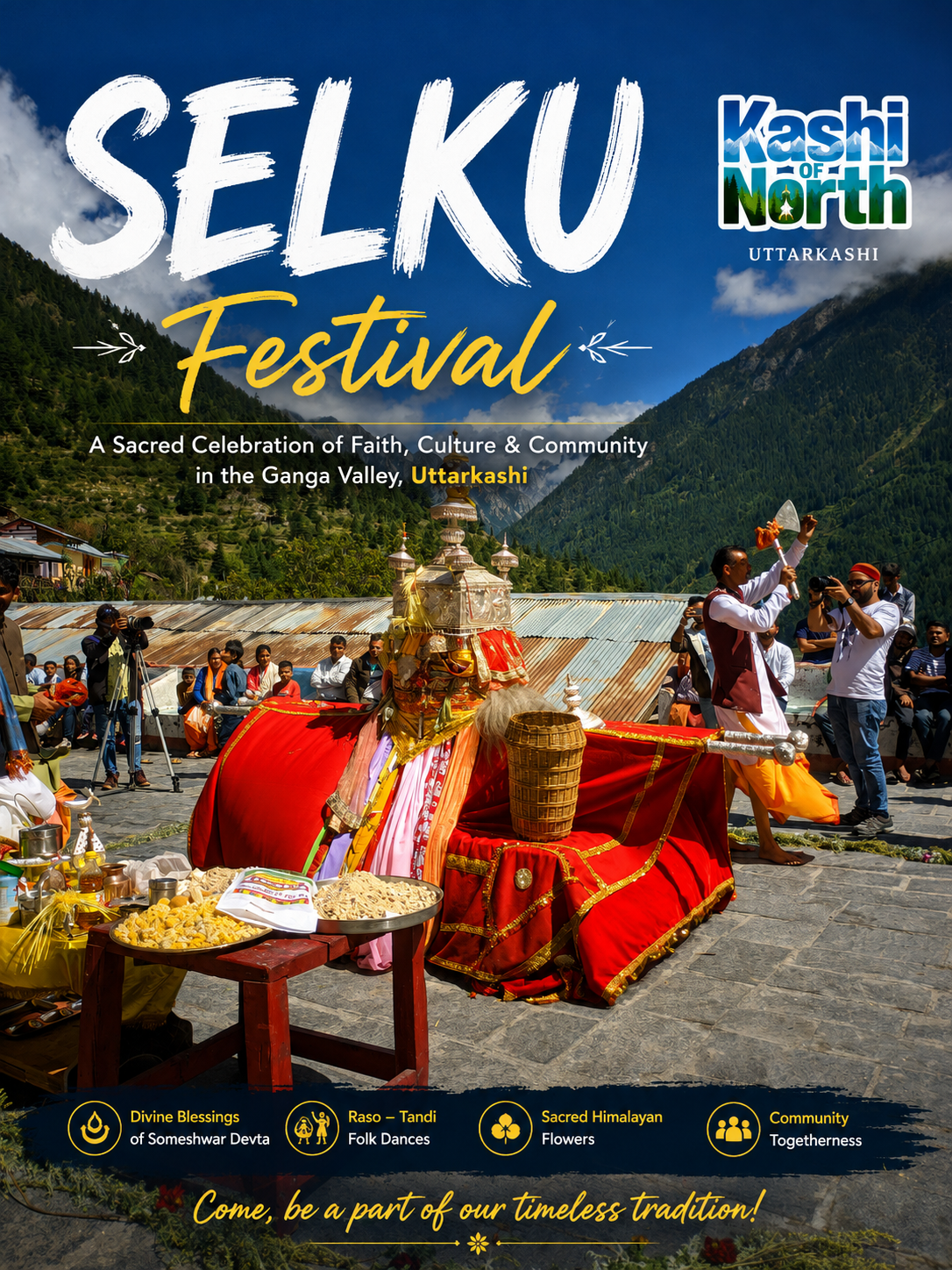
High up in the Ganga (Bhagirathi) Valley, where the monsoon mist still clings to the meadows in late August, the villages of Uttarkashi come alive with drums, dance, and firelight. This is Selku — a festival most outsiders have never heard of, and one that villagers here have never stopped celebrating.
Selku is not a tourist event dressed up in tradition. It is agriculture, faith, and community folded into a single night — and increasingly, thanks to Uttarakhand Tourism’s promotion of the celebration at Syawa Village and Jaurai Bugyal, it’s a festival travelers are beginning to discover for themselves.
This guide covers what Selku Featival is, where selku mela kahan lagta hai (where the Selku fair is actually held), its rituals, its villages, and how you can experience it.
What Is the Selku Festival?

The Selku Festival is a traditional seasonal and nature-worship celebration of the villages of the Ganga/Bhagirathi Valley in Uttarkashi district, particularly the Taknaur, Upper Taknaur, and Nald-Kathud regions around Harsil. It marks the turning point between the green abundance of the monsoon and the approach of autumn and winter, and is celebrated annually, usually around Bhadrapada (roughly late August to September).
Dates vary from village to village rather than falling on one fixed day across the valley — for example, the Jaurai Bugyal/Syawa Village celebration has been held around August 27–28, while Mukhba and Raithal typically observe it in early September.
At its heart, Selku is a festival of gratitude — to the mountains, to the meadow flowers that bloom and fade with the season, and to Someshwar Devta, the local deity most closely associated with the celebration.
The Meaning Behind the Name “Selku”
The word Selku (also written Seluku, सेल्कू/सेलकू/सेलुकू) comes from the Garhwali phrase “Selu Ku” — loosely, “who will sleep?” It’s a fitting name: through the night of the festival, villagers stay awake together, singing, dancing, and taking part in rituals rather than resting.
Where Is Selku Celebrated? (Selku Mela Kahan Lagta Hai)
Selku isn’t one single mela held in one place — it’s a series of village-level festivals that move through the Ganga Valley around the same seasonal window. Depending on the account, the series is understood to begin near Gorshali and build toward Mukhba, or to culminate at Gorshali as the valley’s major closing gathering.
| Village | Region | Notable For |
|---|---|---|
| Gorshali | Taknaur | Gathering of dev dolis, Raso–Tandi dance |
| Raithal | Taknaur | Dev doli gathering, community celebration |
| Saura | Taknaur | Village-level Selku fair |
| Salu | Taknaur | Village-level Selku fair |
| Syaba / Syawa* | Taknaur | Selku at Jaurai Bugyal; tourism department promotion this year |
| Sari | Taknaur | Village-level Selku fair |
| Pilang | Taknaur | Village-level Selku fair |
| Silla | Taknaur | Village-level Selku fair |
| Jakhola | Taknaur | Village-level Selku fair |
| Lata | Taknaur | Village-level Selku fair |
| Bhangeli | Taknaur | Village-level Selku fair |
| Sukki | Upper Taknaur | Village-level Selku fair |
| Jhala | Upper Taknaur | Village-level Selku fair |
| Jaspur | Taknaur | Village-level Selku fair |
| Purali | Taknaur | Village-level Selku fair |
| Dharali | Upper Taknaur | Bhailu fire ritual |
| Mukhba | Upper Taknaur | Winter seat of Goddess Ganga; Bhailu fire ritual |
| Harsil | Upper Taknaur | Regional celebration hub |
| Barsu | Upper Taknaur | Village-level Selku fair |
*Syaba and Syawa are treated here as likely the same village based on spelling variation — please confirm before this is presented as fact in the published article.
The most prominent celebrations today are generally considered to be at Gorshali, Raithal, Mukhba, Dharali, Jhala, Harsil, and — with growing visibility this year — Syawa Village and Jaurai Bugyal.
Traditions and Rituals of Selku
Someshwar Devta and the Sacred Doli
Selku is primarily associated with Someshwar Devta. During the festival, the deity’s doli (palanquin) is brought out and worshipped, and villagers seek blessings for their families, crops, and livestock, along with gratitude for protection through the monsoon.
Bidding Farewell to the Flowers
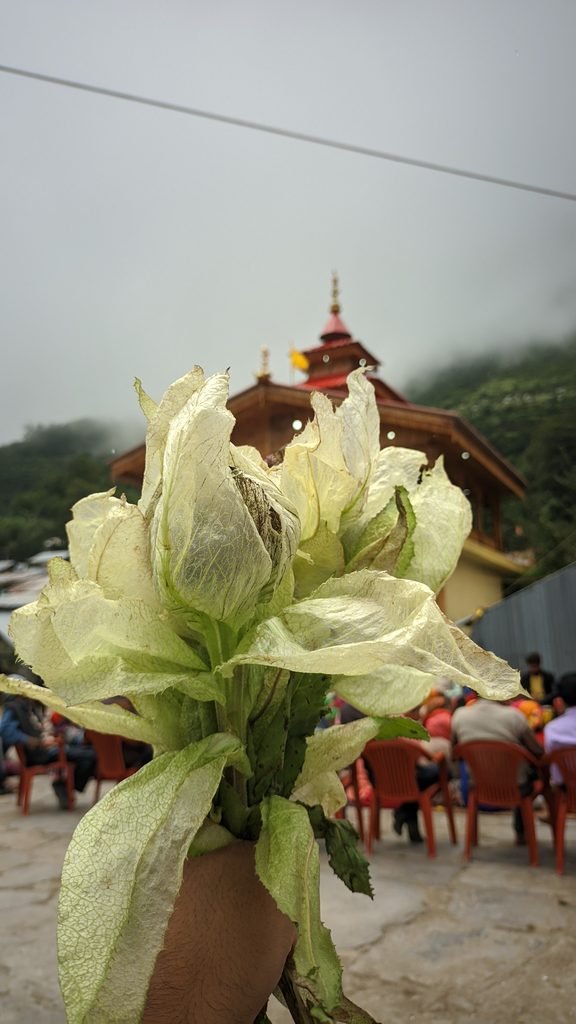
Through the night, villagers climb into the high-altitude meadows (bugyals) to gather sacred Himalayan flowers — especially Brahma Kamal — along with other alpine blooms. These flowers are laid out on ceremonial cloths, and in the morning, folk dances are performed around them as a way of thanking nature before the flowers wither with the coming cold. The temple or that is decorated with these same flowers.
Raso and Tandi — The Traditional Dances
Raso and Tandi, energetic traditional Garhwali circle dances, are performed around the deity’s doli through the night, accompanied by dhol, damau, and other traditional instruments.
The Bhailu Fire Ritual (Mukhba and Dharali)
In Mukhba and Dharali specifically, the festival includes the Bhailu fire-play, a distinct ritual not seen in every Selku village — one of the details that makes each village’s celebration slightly different from the next.
Married Daughters Return Home
Selku is also a festival of homecoming. Married daughters of the village (dhyanis) travel back to their parental homes to take part, making it as much a family reunion as a religious observance.

Selku and the Agricultural Calendar
Selku isn’t only a cultural or religious event — it’s tied directly to farming life in the valley. In several villages, the festival is held before the paddy harvest, and villagers seek Someshwar Devta’s blessing and permission before the harvest begins. In that sense, Selku functions as both a spiritual ritual and a practical marker in the farming year.
When Is Selku Celebrated?
- Jaurai Bugyal / Syawa Village: around August 27–28
- Mukhba and Raithal: typically early September
- Across the wider valley: generally around Bhadrapada (roughly late August–September), with each village setting its own date within that window
Because the celebration moves from village to village rather than happening on a single day, it’s worth checking closer to your travel dates which village is celebrating when.
Selku at Syawa Village and Jaurai Bugyal — This Year’s Highlight
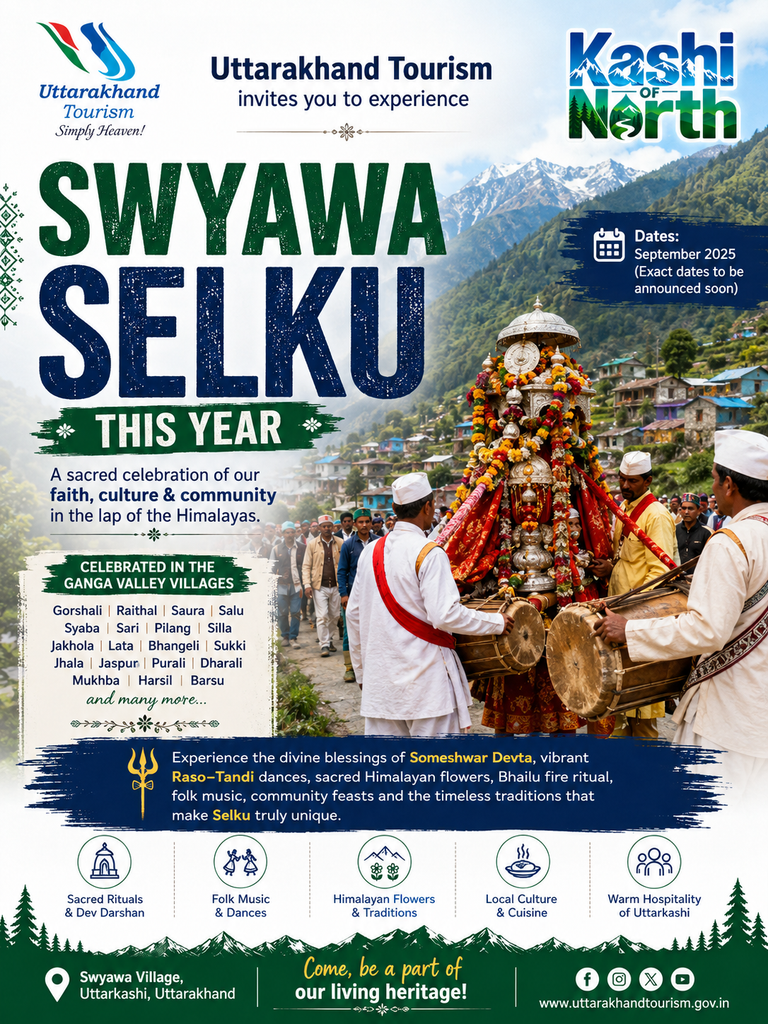
This year, the Uttarakhand Tourism Department has been actively promoting the Selku celebration at Syawa Village and Jaurai Bugyal, bringing renewed attention to a festival that has, for generations, remained largely a local affair.
Alongside the festival, there is also a trek near Syawa Village that the tourism department has been highlighting as part of the same push.
For travelers, this combination — an authentic, centuries-old Himalayan festival paired with a nearby trekking route — makes Syawa Village one of the more exciting emerging additions to the Uttarkashi festival-and-trek circuit this season.
How to Reach the Selku Festival Villages
Most Selku villages — including Harsil, Dharali, Mukhba, Raithal, Gorshali, and Syawa Village — lie along or near the Uttarkashi–Harsil–Gangotri road corridor in the Bhagirathi Valley.
Exact road distances from Dehradun, Rishikesh, and Uttarkashi town to each of these villages haven’t been confirmed for this article yet. Once you share reliable distance/route data, this section can be built out properly with a distance table, similar to the format used in your village profile articles.
Best Time to Visit
Late August through September is the ideal window, timed to coincide with the Selku celebrations themselves. This period also falls right at the seasonal transition the festival marks — the tail end of monsoon greenery giving way to the crisper air of early autumn in the high Himalayan meadows.
Why Selku Matters to Uttarkashi’s Cultural Identity
Selku is far more than a mela. It brings together religion, agriculture, folk music, dance, and village kinship in a single night. The return of married daughters to their maika, the gathering of neighboring villages, and the meeting of different dev-dolis all make it a living expression of the Ganga Valley’s social and cultural identity — not a performance staged for visitors, but a tradition the valley keeps for itself.
Local oral traditions also link Selku’s origins to old trade routes toward Tibet, though these stories vary from village to village and are best understood as local lore rather than a single settled history.
Conclusion
The Selku Festival is one of Uttarkashi’s most authentic living traditions — a night when an entire valley stays awake to honor its deity, its flowers, and its harvest, all at once. With villages from Gorshali to Mukhba each adding their own local color, and with Syawa Village and Jaurai Bugyal now gaining fresh attention through Uttarakhand Tourism’s promotion, Selku is quickly becoming a festival worth planning a trip around — not just reading about. Whether you’re drawn by the Raso-Tandi dances, the Bhailu fire ritual, or the simple idea of a valley refusing to sleep, Selku offers a side of the Himalayas most travelers never get to see.
FAQs
1. What is the Selku Festival of Uttarkashi? Selku is a traditional seasonal and religious festival of the Ganga/Bhagirathi Valley villages in Uttarkashi, marking the transition from monsoon to autumn through night-long worship, dance, and the gathering of high-altitude flowers.
2. Selku mela kahan lagta hai? Selku is celebrated across a cluster of villages in the Taknaur, Upper Taknaur, and Nald-Kathud regions, including Gorshali, Raithal, Mukhba, Dharali, Harsil, Jhala, Sukki, Barsu, and Syawa Village, among others — with each village holding its own celebration on a slightly different date.
3. Why is it called “Selku”? The name comes from the Garhwali phrase “Selu Ku,” meaning “who will sleep,” reflecting the tradition of staying awake all night to sing, dance, and take part in rituals.
4. When is the Selku Festival celebrated? Generally around Bhadrapada (late August to September). Jaurai Bugyal/Syawa Village has held its celebration around August 27–28, while Mukhba and Raithal typically celebrate in early September.
5. Which deity is worshipped during Selku? Someshwar Devta is the deity most closely associated with the Selku Festival, with the deity’s doli central to the night’s rituals.
6. What is the significance of the flowers in Selku? Villagers gather high-altitude meadow flowers, especially Brahma Kamal, through the night and lay them out for morning folk dances as a way of thanking nature before the flowers wither with the onset of winter.
7. Is Selku connected to farming? Yes. In several villages, Selku is held before the paddy harvest, and villagers seek the deity’s blessing and permission before harvesting begins.
8. Is there a trek near the Selku Festival villages? Yes — Uttarakhand Tourism has been promoting a trek near Syawa Village alongside this year’s Selku celebrations at Jaurai Bugyal. Full route details are being confirmed and will be added to this guide.