
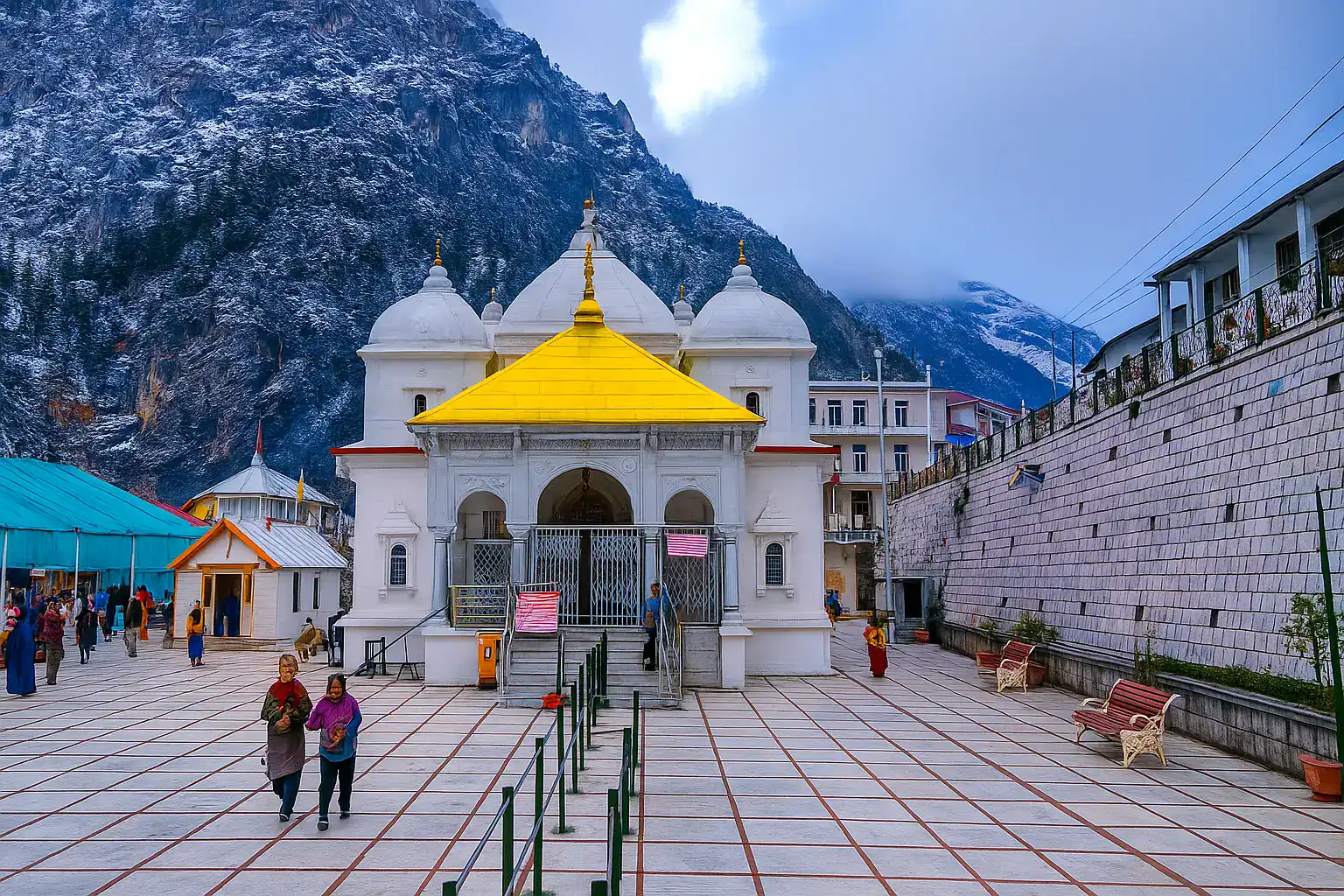
Gangotri Temple sits at roughly 3,048 meters on the banks of the Bhagirathi river in Uttarkashi district, Uttarakhand, and is one of the four sacred Char Dham sites of the Himalayan pilgrimage circuit. It’s the temple closest to the actual source of the Ganga — the Gangotri Glacier, whose snout at Gaumukh sits about 18 km further up the valley, reachable only on foot. Few pilgrimage destinations anywhere combine what Gangotri does: a temple of major religious significance, a glacier source you can physically walk to, and a ring of 6,000+ meter peaks (Shivling, Thalay Sagar, the Bhagirathi group) visible from the approach.
This guide covers temple timings and dates, the Char Dham registration process, the Gaumukh Trek in full detail, distances from every major city, and over 40 answered questions — everything needed to plan a Gangotri visit properly, whether it’s a two-day darshan trip or a full Char Dham circuit with a trek attached.
Important note: Temple opening and closing dates, Char Dham registration requirements, permits, and prices change annually. This guide reflects information understood as of mid-2026 — always verify current details at registrationandtouristcare.uk.gov.in and with the Gangotri National Park Forest Department before traveling.
Where Is Gangotri?
Gangotri is a Hindu pilgrimage town in Uttarkashi district, Uttarakhand, sitting at approximately 3,048–3,100 meters on the left bank of the Bhagirathi river in the western Garhwal Himalaya, roughly 100 km from Uttarkashi and 250–265 km from Rishikesh.
The town itself is compact — the temple, a cluster of guesthouses and dharamshalas, a small pilgrim market, and the Gangotri National Park forest office. Around it, Deodar and Himalayan pine give way to birch and then rocky moraine higher up, with the Gangotri Group peaks — Shivling, Thalay Sagar, Kedar Dome, Meru, and the Bhagirathi massif — visible above the valley on clear days.
The Gangotri Temple
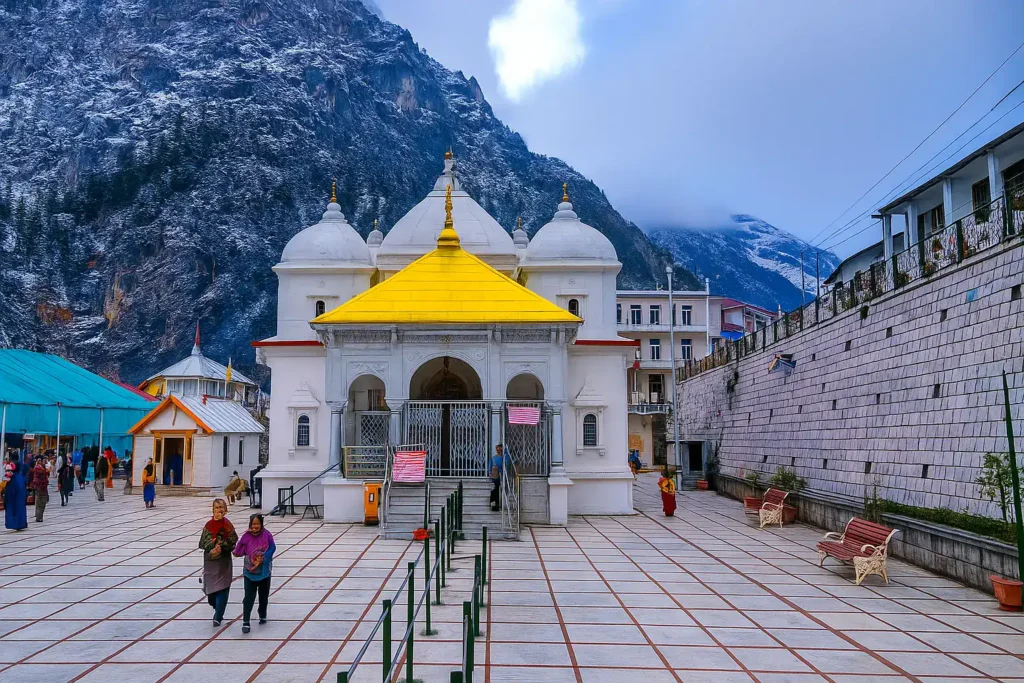
The Gangotri Temple, dedicated to Goddess Ganga, was built by Gorkha General Amar Singh Thapa in the early 18th century and later restored by Maharaja Madho Singh II of Jaipur in the early 20th century, standing today as a white granite structure on the Bhagirathi’s left bank.
Architecture
The temple is built in traditional North Indian style, rising about 20 feet with three cupolas topped with golden spires, and features more elaborate wall carvings than several of the other Char Dham temples. The idol of Goddess Ganga sits in the Garbhagriha (inner sanctum), reached after crossing the Sabha Mandap. The Pujaris and Brahmins serving the temple belong to Mukhba village, with the Semwal family documented as the traditional priestly lineage.
Bhagirath Shila and Jalmagna Shivling
The Bhagirath Shila, within the temple precinct, marks the spot where King Bhagiratha is believed to have performed penance to Lord Shiva — circumambulating and touching it is considered sacred. The Jalmagna Shivling, a natural Shiva lingam submerged in the river through most of the year, becomes visible only in late autumn or early winter when water levels drop, believed to mark the spot where Shiva caught the descending Ganga in his hair.
Temple Timings
| Session | Timings |
|---|---|
| Morning | 6:15 AM – 2:00 PM |
| Afternoon break | 2:00 PM – 3:00 PM |
| Evening | 3:00 PM – 9:30 PM |
| Evening Sandhya Aarti | ~7:45 PM (summer), ~7:00 PM (later in season) |
Timings may shift on festival days. Arrive by 6:15 AM for shorter darshan queues, especially in peak season when waits can run 2–4 hours.
Opening and Closing
The temple opens each year on Akshaya Tritiya — April 19, 2026 for this season, though the exact date shifts annually and should be verified officially — with a grand procession carrying the Goddess Ganga idol from Mukhba village, accompanied by Vedic chants and thousands of pilgrims. It closes on Bhai Dooj (two days after Diwali, roughly November 10, 2026), when the idol is carried back to Mukhba for winter worship at the Mukhimath Temple.
Temple Etiquette
- Dress modestly, covering shoulders and legs; remove footwear before entering
- Photography inside the Garbhagriha is generally not permitted
- Keep phones on silent inside the temple
- Don’t buy religious items from vendors claiming official status inside the complex
- Maintain respectful silence during Aarti
Planning your Gangotri darshan around the temple’s opening or closing ceremony? Kashi of North can confirm current dates and arrange your accommodation around peak pilgrimage days — call or WhatsApp +91 7253079221.
Why Gangotri Is Important
Gangotri holds a rare combination of significance: it’s one of the four Char Dhams of the Himalayan pilgrimage circuit, it’s the temple closest to the actual glacial source of the Ganga (Hinduism’s most sacred river), and its water — collected in copper vessels by pilgrims — is used in rituals and consecrations across India. Unlike some other pilgrimage sites, Gangotri also sits at the doorstep of serious high-altitude trekking and mountaineering, meaning the same journey can serve a pilgrim seeking darshan and a trekker seeking the Gaumukh glacier snout.
History of Gangotri
Gangotri’s documented history runs from ancient scriptural references through Gorkha-era temple construction, Rajput-era restoration, and into the modern, heavily regulated Char Dham pilgrimage system of today.
Before the formal temple existed, the site was already a pilgrimage destination centered on the Bhagirath Shila. The temple itself was constructed by Gorkha General Amar Singh Thapa in the early 18th century, during the period of Gorkha control over Garhwal — Thapa was later defeated by British forces in the Anglo-Nepalese War of 1814–16. In the early 20th century, Maharaja Madho Singh II of Jaipur funded the temple’s restoration, part of a broader tradition of Rajput royal patronage of Himalayan shrines.
British surveyor H.R. Webb is credited with first mapping the Gangotri Glacier in 1808, beginning a long history of scientific documentation that continues today through institutions like the Wadia Institute of Himalayan Geology, which monitors the glacier’s well-documented retreat.
Char Dham registration itself, now mandatory for all pilgrims, was introduced after the 2013 Kedarnath floods and has evolved from biometric registration to the current QR-code e-pass system, with Aadhaar linkage made mandatory from 2026.
Mythology and Religious Significance
The following presents Hindu religious tradition as believed and practiced — a devotional narrative, not a historical claim.
According to tradition, King Bhagiratha, a descendant of King Sagara, undertook extraordinary penance on the banks of the Bhagirathi to bring the Ganga down from heaven, so her waters could flow over the ashes of his 60,000 ancestors and release their souls. After propitiating Brahma and then Shiva, Shiva agreed to catch the descending river in his matted hair to break the force of her fall. The spot where the Ganga first touched earth — where Shiva’s locks received her — is Gangotri, and the river is named Bhagirathi after the king whose devotion brought her down.
This story appears across several major texts, including the Valmiki Ramayana’s Bala Kanda, the Srimad Bhagavatam’s ninth skandha, the Skanda Purana’s pilgrimage sections, and the Mahabharata’s Vana Parva. Local tradition also associates the nearby Pandava Gufa cave with the Pandavas’ meditation before their final Himalayan journey.
Char Dham Yatra: The Complete Guide
Gangotri is one of four sacred Himalayan dhams — alongside Yamunotri, Kedarnath, and Badrinath — that together form the Chota Char Dham circuit, traditionally visited in the sequence Yamunotri → Gangotri → Kedarnath → Badrinath.
| Dham | River | Deity | Altitude | Season |
|---|---|---|---|---|
| Yamunotri | Yamuna (source) | Goddess Yamuna | ~3,293 m | Akshaya Tritiya – Diwali |
| Gangotri | Bhagirathi (Ganga source) | Goddess Ganga | ~3,048 m | Akshaya Tritiya – Bhai Dooj |
| Kedarnath | Mandakini | Lord Shiva (Jyotirlinga) | ~3,583 m | Akshaya Tritiya – Bhai Dooj |
| Badrinath | Alaknanda | Lord Vishnu | ~3,133 m | Late April – November |
Char Dham Registration (Mandatory)
Registration is mandatory for every pilgrim visiting Gangotri, entirely free, and required to pass checkpoints along the route.
- Official portal: registrationandtouristcare.uk.gov.in
- App: Tourist Care Uttarakhand (Google Play / App Store)
- WhatsApp: +91 8394833833 (official Uttarakhand government registration line)
- Offline counters: Rishikesh and Haridwar, from mid-April
- Aadhaar is mandatory for Indian nationals from 2026; foreign nationals register using their passport
The process: enter Aadhaar/passport details, travel dates, and destinations, then receive a Yatra Registration Letter with a unique QR code. Print multiple copies, since mobile data is unreliable in the Himalayan sections, and show the QR code at checkpoints throughout the route.
Standard 12–14 Day Char Dham Itinerary from Haridwar
Day 1: Haridwar → Barkot (Yamunotri base). Day 2: Yamunotri darshan via 6 km trek from Janki Chatti. Day 3–4: Barkot → Uttarkashi. Day 5: Uttarkashi → Gangotri. Day 6: Gangotri darshan and evening Aarti. Day 7: Optional Gaumukh day hike or trek start. Day 8: Gangotri → Kedarnath base. Day 9: Kedarnath darshan. Day 10: Kedarnath → Badrinath. Day 11: Badrinath darshan. Day 12: Return to Rishikesh/Haridwar.
Doing the full Char Dham circuit and want it planned end to end? Kashi of North puts together complete Char Dham itineraries with hotels, taxis, and registration guidance included.
Gangotri Valley: Geography and Ecology
Gangotri sits within Gangotri National Park, established in 1989 and covering roughly 1,553 sq km, recognized as part of the Western Himalayan Snow Leopard Conservation Landscape. The park protects the glacier system, the Bhagirathi headwaters, Gaumukh, Tapovan, and Nandanvan, along with documented populations of snow leopard, Himalayan black bear, musk deer, Himalayan tahr, and blue sheep.
The Bhagirathi River, technically distinct from the Ganga until it merges with the Alaknanda at Devprayag, is treated in pilgrimage practice as already being the Ganga at Gangotri — cold, fast, and close to glacial temperature year-round.
The Gaumukh Trek
Gaumukh — “cow’s mouth” — is the snout of the Gangotri Glacier, roughly 18 km up the valley from Gangotri town at approximately 3,900–4,023 meters, and is both the literal source of the Bhagirathi River and one of the most accessible glacier treks in the Indian Himalaya.
| Detail | Information |
|---|---|
| Starting point | Gangotri (~3,048–3,100 m) |
| Destination | Gaumukh glacier snout (~3,900–4,023 m) |
| One-way distance | ~18 km |
| Difficulty | Easy to Moderate |
| Standard duration | 2 days (overnight at Bhojbasa) |
| Permit | Mandatory, ~₹150/person (Indians), 150 trekkers/day limit |
| Key campsite | Bhojbasa (~3,800 m, 14 km from Gangotri) |
| Season | April–mid-June; mid-September–November |
| Drones | Strictly prohibited |
Permit Process
Permits are issued at the Forest Department counter at the Gangotri National Park gate — carry a government-issued photo ID and arrive early in peak season, since the 150-person daily cap can fill by mid-morning.
The Route
Gangotri to Chirbasa (~9 km, 2–3 hours, ~3,600 m): A gentle ascent along the Bhagirathi’s right bank through pine and Deodar forest, named for its Chir Pine trees.
Chirbasa to Bhojbasa (~5 km, 2–3 hours, ~3,800 m): Forest thins to birch and sparse scrub. Bhojbasa, named for the Bhojpatra (Himalayan birch) trees, sits beside the river with Bhagirathi Peaks views and is the only designated overnight zone before Gaumukh.
Bhojbasa to Gaumukh (~4 km, 2–3 hours, ~3,900–4,023 m): Crosses a boulder field and moraine — tougher than the distance suggests. The glacier ice wall can reach 15–30 meters at the snout. Camping isn’t permitted at Gaumukh itself — return to Bhojbasa for the night.
Accommodation at Bhojbasa
| Option | Approx. Price | Notes |
|---|---|---|
| GMVN Tourist Rest House | ₹1,500/bed | Dormitory, book at gmvnl.com |
| Lal Baba Ashram | ₹350–₹600/person | Basic dormitory, meals included |
| Ram Baba Ashram | ₹350–₹600/person | Similar to Lal Baba |
Tapovan Extension
Tapovan (~4,460 m) is a high meadow above Gaumukh with direct Shivling views, adding roughly 6 km and involving a glacier crossing — recommended only for acclimatized, experienced trekkers, extending the trip to 4–5 days total.
Trek Safety
Acclimatize at Gangotri for at least one night before starting. Begin each day’s walk by 6:00–7:00 AM to return before afternoon cloud builds. Don’t approach the glacier snout too closely, since ice calving and rockfall are real hazards. Carry all water needed for the Gaumukh section from Bhojbasa.
Want your Gaumukh permit and Bhojbasa accommodation sorted in advance? Kashi of North handles permit and trek logistics — WhatsApp +91 7253079221.
Other Treks from Gangotri
| Trek | Distance | Altitude | Duration | Notes |
|---|---|---|---|---|
| Kedar Tal | 17 km one-way | ~4,425 m | 3–4 days | Below Thalay Sagar, more demanding than Gaumukh |
| Tapovan | +6 km beyond Gaumukh | ~4,460 m | 4–5 days total | Shivling views, glacier crossing required |
| Nandanvan | Beyond Tapovan | ~4,300 m | 6–8 days | Chaturangi Glacier views, advanced expedition territory |
| Kalindi Khal | Gangotri to Badrinath | ~5,947 m | Multi-day | High mountaineering pass, ropes/crampons required |
Places to Visit Near Gangotri
| Place | Distance | Time Required | Best Time |
|---|---|---|---|
| Bhagirath Shila | Within temple complex | 15 minutes | Year-round |
| Surya Kund | ~1 km | 30 minutes | Year-round |
| Gauri Kund | ~500 m | 20 minutes | Year-round |
| Pandava Gufa | ~1 km upstream | 30–45 minutes | Year-round |
| Bhaironghati | ~9 km | 30–60 minutes | Season only |
| Harsil | ~25–28 km | Half to full day | Year-round |
| Mukhba Village | ~21–23 km | Half day | Year-round |
| Dharali | ~20–22 km | Half day | Check current status |
| Gangnani Hot Spring | ~65 km | 2–3 hours | Year-round |
Surya Kund and Gauri Kund, both within a kilometer of the temple, are traditional bathing and meditation spots. Pandava Gufa ties into local Mahabharata tradition. Bhaironghati, roughly 9 km south, is the dramatic confluence of the Bhagirathi and Jadh Ganga and the gateway checkpoint for Nelong Valley.
Gangotri Distance Table
| Origin | Distance | Approx. Time |
|---|---|---|
| Delhi | ~490–510 km | 13–15 hours |
| Dehradun | ~248–260 km | 8–9 hours |
| Haridwar | ~262–278 km | 8–9 hours |
| Rishikesh | ~250–265 km | 7–9 hours |
| Uttarkashi | ~100 km | 3–3.5 hours |
| Harsil | ~25–28 km | 45–60 minutes |
| Bhaironghati | ~9 km | 20–25 minutes |
| Yamunotri | Via Uttarkashi/Barkot | Separate route, not directly connected |
How to Reach Gangotri
By Road: The standard route runs Rishikesh → Chamba → Tehri → Dharasu → Uttarkashi → Maneri → Bhatwari → Harsil → Bhaironghati → Gangotri on NH-108/NH-34. The road is paved throughout but narrows significantly past Uttarkashi, with the Harsil–Gangotri stretch (25–28 km) being dramatic, cliff-edge driving alongside the Bhagirathi.
By Bus: State and private buses run regularly from Rishikesh and Haridwar to Uttarkashi (₹300–₹500), with seasonal buses continuing to Gangotri (₹200–₹350) during the Yatra season.
By Taxi: A private taxi from Rishikesh to Gangotri runs roughly ₹5,000–₹8,000; from Uttarkashi, ₹2,000–₹3,500.
By Air: The nearest airport is Jolly Grant Airport (DED), Dehradun, roughly 250 km away, with daily flights from Delhi.
By Train: The nearest railway stations are Rishikesh (~234 km) and Haridwar (~265 km).
Self-drive: Budget 8–9 hours from Dehradun. An SUV is strongly recommended from Uttarkashi onward, and drivers should fill up completely in Uttarkashi — Gangotri’s fuel availability is seasonal and shouldn’t be relied on. Vehicles park in a designated area roughly 500 m from the temple; no vehicles enter the pedestrian zone.
Not keen on the 8-hour drive from Dehradun yourself? Kashi of North arranges private taxis and Char Dham transport with drivers experienced on this exact route.
Where to Stay
All accommodation in Gangotri is seasonal, operating only from roughly April/May to October/November.
| Type | Price/Night | Notes |
|---|---|---|
| GMVN Tourist Bungalow | ₹1,000–₹2,500 | Government-run, book at gmvnl.com |
| Budget guesthouses | ₹400–₹1,200 | Basic, functional |
| Mid-range guesthouses | ₹1,200–₹2,500 | Private bathrooms |
| Dharamshalas | ₹100–₹500 (donation-based) | Very basic, pilgrim-oriented |
Book well in advance for May–June and September–October. For more comfortable options, base at Harsil (25–28 km south) and day-trip to Gangotri.
Booking during peak Char Dham season can be genuinely difficult without local contacts. Kashi of North handles hotel and GMVN bookings for Gangotri and Harsil — call or WhatsApp +91 7253079221.
Best Time to Visit
May–June and September–October are the two best windows to visit Gangotri, offering the most comfortable temperatures, open Gaumukh Trek access, and the clearest mountain views of the season.
- Late April–June: Comfortable temperatures (8°C–18°C), Gaumukh Trek open, busiest period of the year.
- July–mid-September (monsoon): Reduced pilgrim numbers, landslide risk on the approach road, Gaumukh Trek closed.
- Mid-September–early November: The finest season — clear post-monsoon skies, brilliant light, Gaumukh reopens, moderate crowds, but nights turn cold (-2°C to 2°C) from October.
- November–April: Temple closed, town inaccessible under snow.
Month-by-Month Weather Guide
| Month | Day Temp | Night Temp | Temple | Gaumukh Trek |
|---|---|---|---|---|
| January | -8°C to 0°C | -15°C to -20°C | Closed | Closed |
| February | -6°C to 2°C | -12°C to -16°C | Closed | Closed |
| March | -2°C to 6°C | -8°C to -12°C | Closed | Closed |
| April | 4°C to 12°C | -4°C to 0°C | Opens Akshaya Tritiya | Opens ~April 1 |
| May | 8°C to 18°C | 0°C to 4°C | Open | Open |
| June | 10°C to 20°C | 4°C to 8°C | Open | Closes mid-June |
| July | 10°C to 18°C | 6°C to 10°C | Open (reduced) | Closed |
| August | 10°C to 18°C | 6°C to 10°C | Open (reduced) | Closed |
| September | 8°C to 16°C | 2°C to 6°C | Open | Reopens mid-Sept |
| October | 4°C to 12°C | -2°C to 2°C | Open | Open |
| November | -4°C to 4°C | -8°C to -12°C | Closes Bhai Dooj | Closes with snow |
| December | -8°C to -2°C | -14°C to -20°C | Closed | Closed |
Festivals
Akshaya Tritiya marks the temple’s annual opening — one of the most auspicious days in the Hindu calendar. Ganga Dussehra, usually in May–June, marks the mythic descent of the Ganga. Special puja is performed at the temple on Janmashtami, Vijaydashmi, and Diwali, and the temple’s closing on Bhai Dooj marks the formal end of the pilgrimage season, when the idol returns to Mukhba.
Wildlife
Gangotri National Park’s documented species include the snow leopard (flagship species, rarely sighted), Himalayan black bear, musk deer, Himalayan tahr, and blue sheep, along with birds including the Himalayan monal, Himalayan snowcock, Himalayan griffon, and golden eagle. River birds along the Bhagirathi at Gangotri include the brown dipper, plumbeous water redstart, and little forktail.
Food Guide
Gangotri is strictly vegetarian — no non-vegetarian food is available anywhere in town. Highway dhabas near the market serve dal-rice, sabzi-roti, aloo paratha, and chapati, and tea stalls run throughout the day. Sweet prasad (halwa, laddoos) is sold by vendors near the temple. On the Gaumukh Trek, Chirbasa has a basic tea stall, Bhojbasa ashrams serve simple meals, and beyond Bhojbasa you’ll need to carry your own food. At altitude, eat light, hydrate constantly, and carry high-energy snacks like dry fruit, nuts, and glucose tablets.
Suggested Itineraries
2 Days (Standard Pilgrim): Day 1 — drive from Uttarkashi/Rishikesh, arrive Gangotri, evening Aarti. Day 2 — morning darshan, Bhagirath Shila, Surya Kund, Pandava Gufa, departure.
4–5 Days (Pilgrim + Gaumukh Trek): Day 1 — arrive Gangotri. Day 2 — darshan, acclimatization, collect Gaumukh permit. Day 3 — Gangotri to Bhojbasa. Day 4 — Bhojbasa to Gaumukh and back, return to Gangotri. Day 5 — final darshan, departure.
Char Dham Full Circuit (12–14 days): See the Char Dham Yatra section above.
Want this itinerary built around your exact dates and group size? Kashi of North designs custom Gangotri and Char Dham itineraries — WhatsApp +91 7253079221.
Travel Budget
| Category | Per Person/Day |
|---|---|
| Budget pilgrim | ₹2,000–₹3,500 |
| Mid-range | ₹2,500–₹4,000 |
| Comfort | ₹5,000–₹10,000+ |
Rough cost breakdown includes accommodation (₹1,000–₹10,000 depending on category), meals (₹450–₹8,000), transport from Rishikesh (₹500–₹10,000), the Gaumukh permit (~₹150), Bhojbasa accommodation (₹1,000–₹4,000), and puja/prasad expenses (₹100–₹2,000).
Photography Guide
The temple is most photogenic at dawn, when soft light catches the white granite and golden spires, and the evening Ganga Aarti is a striking ritual photography subject. The river photographs best at dawn and dusk, with a polarizing filter revealing its turquoise-green color at its clearest. Mountain views are typically best on clear mornings in May–June and September–October, with sunrise alpenglow on Shivling and the Bhagirathi Peaks from Bhojbasa ranking among the finest mountain photography moments in the Himalaya. At 3,048 m with minimal light pollution, Gangotri also makes an excellent dark-sky location for astrophotography, particularly around new moon in September–October.
Drones are strictly prohibited throughout Gangotri National Park, including the town and the entire Gaumukh trail. Photograph pilgrims respectfully, never obstruct the path to the temple, and avoid photography inside the Garbhagriha without explicit permission.
Practical Travel Information for Gangotri Dham
Mobile network: BSNL and Jio work in Gangotri town; Airtel is limited, and there’s no network at all on the Gaumukh trail.
ATMs: Limited seasonal ATMs in Gangotri — carry sufficient cash from Uttarkashi.
Fuel: Seasonal in Gangotri; fill up completely in Uttarkashi to be safe.
Medical facilities: Basic first aid only in Gangotri; the nearest hospital is in Uttarkashi, roughly 100 km and 3–3.5 hours away.
Altitude: Gangotri (3,048 m), Bhojbasa (3,800 m), and Gaumukh (~4,000 m) all carry genuine altitude sickness risk. Spend a night in Uttarkashi before Gangotri, and one acclimatization night at Gangotri before heading to Bhojbasa. Watch for headache, nausea, dizziness, and fatigue; confusion or a pink frothy cough are severe warning signs requiring immediate descent.
Packing List
- Documents: government ID, printed Char Dham registration letter, Gaumukh permit, vehicle papers
- Clothing: thermal base layer, fleece mid-layer, insulated jacket, windproof shell
- Footwear: waterproof trekking boots (broken in), camp sandals, warm socks
- Sleeping bag rated to -10°C if overnighting at Bhojbasa
- Sunscreen SPF 50+, SPF lip balm
- Insulated water bottle and purification tablets
- First-aid kit, altitude medication (consult a doctor), paracetamol
- Headlamp, power bank, offline maps
- Trekking poles, gaiters, backpack rain cover
- Copper vessel (lota) for Gangajal, puja materials
Emergency Contacts
| Service | Contact |
|---|---|
| Emergency | 112 |
| Uttarakhand Tourist Helpline | 1364 |
| SDRF Uttarkashi | 01374-222694 |
| Kashi of North Travel Assistance | +91 7253079221 |
Responsible Tourism
Carry a reusable water bottle and a waste bag — single-use plastic bags are banned in Uttarakhand, and everything you bring in should be carried back out. Dress modestly at the temple, and never wash clothes or vehicles in the Bhagirathi, which remains the direct source of drinking water for hundreds of millions downstream. On the Gaumukh Trek, camp only at Bhojbasa, use ashram waste facilities, and don’t collect flowers, plants, or minerals. Never approach or attempt to attract wildlife, and report any signs of poaching to the forest office.
Common Mistakes to Avoid
- Not registering for Char Dham Yatra — the QR e-pass is checked at multiple checkpoints, and without it you’ll be turned back
- Arriving without booked accommodation, since peak-season Gangotri fills days in advance
- Skipping acclimatization before the Gaumukh Trek — driving straight from Rishikesh and starting the trek the next morning is the most common cause of altitude sickness on this route
- Missing the evening Aarti, one of the most moving parts of the visit
- Not filling fuel at Uttarkashi, since Gangotri’s supply is seasonal
- Underpacking for cold — even May evenings at 3,048 m can approach freezing
- Not printing documents, given unreliable mobile data at Gangotri
- Attempting the Gaumukh Trek during its mid-June to mid-September closure, when the route becomes genuinely dangerous
- Polluting the Bhagirathi in any way
Conclusion
Gangotri combines things that rarely sit together in one place: a temple of major religious significance, a glacier source you can physically walk to, and 6,000+ meter peaks visible from the approach road. The pilgrimage itself is an act of faith; the walk to Gaumukh is an act of physical and geological witness — and when both happen on the same trip, the experience is about as complete as Himalayan pilgrimage travel gets.
Come prepared: register before leaving home, book accommodation ahead, acclimatize properly, and carry out everything you carry in.
Ready to plan your Gangotri trip? Kashi of North handles hotel and GMVN bookings, private taxis, Gaumukh Trek permits, local guides, and full Char Dham itineraries.
📞 Call/WhatsApp: +91 7253079221 📧 Email: kashiofnorth@gmail.com 🌐 Website: kashiofnorth.com
Frequently Asked Questions
1. What is Gangotri? Gangotri is a sacred Hindu pilgrimage town in Uttarkashi district, Uttarakhand, at roughly 3,048 meters on the Bhagirathi river, one of the four Char Dham sites and the closest temple town to the Ganga’s glacial source.
2. When does Gangotri Temple open in 2026? April 19, 2026 (Akshaya Tritiya). The exact date changes annually — always verify officially before travel.
3. When does Gangotri Temple close in 2026? Approximately November 10, 2026 (Bhai Dooj) — verify the official date each year.
4. What are the Gangotri Temple timings? Morning 6:15 AM–2:00 PM, evening 3:00 PM–9:30 PM, with evening Aarti around 7:45 PM in summer.
5. Is Char Dham registration mandatory for Gangotri? Yes, for every pilgrim, free of charge, via registrationandtouristcare.uk.gov.in.
6. How far is Gangotri from Rishikesh? Roughly 250–265 km, 7–9 hours by road.
7. How far is Gangotri from Delhi? Roughly 490–510 km, 13–15 hours by road.
8. How far is Gaumukh from Gangotri? About 18 km one-way on the Gaumukh Trek.
9. Do I need a permit for the Gaumukh Trek? Yes, approximately ₹150/person for Indians, with a 150-trekker daily limit, obtained at the Forest Department counter at the park gate.
10. What is the altitude of Gangotri? Approximately 3,048–3,100 meters.
11. Is non-vegetarian food available at Gangotri? No, Gangotri is strictly vegetarian.
12. Where is Goddess Ganga worshipped in winter? At the Mukhimath Temple in Mukhba village, roughly 21–23 km south of Gangotri, where the idol is carried when the temple closes.
13. What is the best time to visit Gangotri? May–June for comfortable temperatures and an open Gaumukh Trek, or September–October for the clearest post-monsoon skies.
14. Can foreign tourists visit Gangotri? Yes, with no restrictions on the town itself, though Nelong Valley beyond Bhaironghati is restricted to Indian nationals only.
15. What is the Bhagirath Shila? The holy rock within the temple complex where King Bhagiratha is believed to have worshipped Shiva.
16. What is the Jalmagna Shivling? A natural Shiva lingam submerged in the Bhagirathi through most of the year, visible only when water levels drop in late autumn.
17. Who built the Gangotri Temple? Gorkha General Amar Singh Thapa, in the early 18th century.
18. Who restored the Gangotri Temple? Maharaja Madho Singh II of Jaipur, in the early 20th century.
19. What is Bhojbasa? The only designated overnight zone on the Gaumukh Trek, at roughly 3,800 meters, 14 km from Gangotri.
20. Can I do the Gaumukh Trek in one day? Fast, experienced trekkers can manage the 36 km round trip in a single very long day, but a 2-day itinerary with a Bhojbasa overnight is strongly recommended.
21. What is Tapovan? A high meadow at roughly 4,460 meters above Gaumukh with direct Shivling views, accessible as a 4–5 day extension for experienced, acclimatized trekkers.
22. Is camping allowed at Gaumukh? No, camping at the snout itself is prohibited — camp at Bhojbasa only.
23. What is Gangotri National Park? Established in 1989, covering roughly 1,553 sq km, protecting the Gangotri Glacier, Bhagirathi headwaters, and documented snow leopard, black bear, musk deer, tahr, and blue sheep populations.
24. Is the road to Gangotri open year-round? No, it closes under snow roughly from November to April, with exact dates depending on annual snowfall.
25. Is there an ATM at Gangotri? Limited, seasonal ATMs — carry sufficient cash from Uttarkashi.
26. Is fuel available in Gangotri? Seasonally, but unreliable — fill up completely in Uttarkashi before heading up.
27. What mobile networks work in Gangotri? BSNL and Jio work in town; Airtel is limited, and there’s no coverage on the Gaumukh trail.
28. What is the significance of Gangajal from Gangotri? Water collected here is considered the purest Gangajal, used in Hindu rituals, funeral rites, and temple consecrations across India.
29. Is a guide mandatory for the Gaumukh Trek? Not for the standard Gangotri–Gaumukh route, which is well-marked, but strongly recommended and effectively necessary for the Tapovan extension.
30. Can senior citizens visit Gangotri? Yes, with medical caution — consult a doctor beforehand and spend a night in Uttarkashi first; the Gaumukh Trek itself is generally not recommended for most seniors.
31. What is the traditional Char Dham Yatra sequence? Yamunotri → Gangotri → Kedarnath → Badrinath.
32. What is Kedar Tal? A high-altitude lake at roughly 4,425 meters, reached via a 17 km, 3–4 day trek from Gangotri below Thalay Sagar.
33. Is the Gangotri Glacier retreating? Yes, documented studies show retreat of roughly 22 meters per year in recent decades.
34. What are the major peaks visible from the Gaumukh Trek? Shivling, the three Bhagirathi peaks, Thalay Sagar, Kedar Dome, and Meru.
35. Can I take a holy dip near the Gangotri Temple? Yes, at the ghats adjacent to the temple, and at Surya Kund and Gauri Kund — water temperature stays around 4°C–8°C year-round.
36. Is there medical care at Gangotri? Basic first aid only; the nearest hospital is in Uttarkashi, roughly 100 km away.
37. What should I do if I feel altitude sick at Gangotri? Rest, hydrate, take paracetamol for headache, and descend immediately if symptoms worsen — contact SDRF or call 112 in an emergency.
38. What is the significance of Bhai Dooj for the temple closing? Bhai Dooj, two days after Diwali, marks the traditional end of the pilgrimage season and the point when the idol returns to Mukhba for winter.
39. Is insurance required for the Gaumukh Trek? Not mandatory, but strongly recommended, particularly a policy covering high-altitude trekking and emergency helicopter evacuation.
40. How many days should I plan for Gangotri? Minimum 2 days for darshan only, 4–5 days including the Gaumukh Trek, or 6–7 days if adding the Kedar Tal trek.
41. What is the significance of Mukhba for Gangotri? Mukhba is the winter abode of Goddess Ganga and the home village of the Gangotri Temple’s priestly family — when the temple closes, the idol is ceremonially carried there.
42. Which Char Dhams are in Uttarkashi District? Both Gangotri and Yamunotri sit within Uttarkashi district, making it the most significant single pilgrimage district in Uttarakhand.
For more from Uttarkashi District, explore our guides to Harsil, Mukhba, Dharali, Bagori, Gangnani, Bhaironghati, Nelong Valley, Jadung Village, Jhala, Gaumukh Trek, Tapovan Trek, Kedar Tal Trek, Hotels in Gangotri, Hotels in Harsil, Taxi Services, and the full Char Dham Yatra Guide.